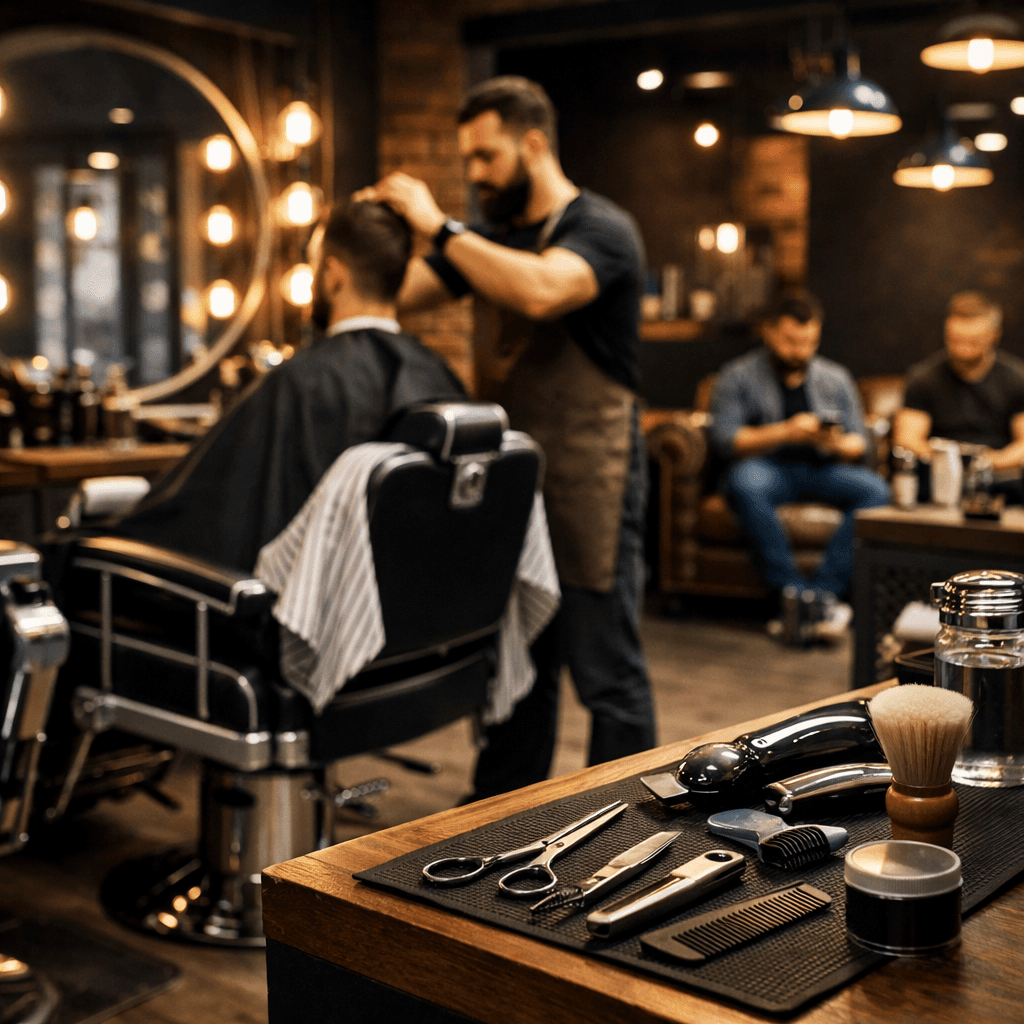
Walk-in customers are the lifeblood of most barbershops — but they are also the hardest to manage. The direct answer: barbershops lose customers not because the wait is too long, but because the wait feels uncertain. Shops that give walk-ins visibility into their wait time reduce walkouts by up to 60% and recover tens of thousands in annual lost revenue.
According to the National Association of Barbers of America, the walk-in model accounts for 50–80% of revenue at most barbershops. Yet a Zenoti industry report found that 50% of barbershop customers say waiting around is the most frustrating part of their visit. That frustration drives walkouts — and walkouts drive permanent customer loss.
This guide covers the real reasons walk-in customers leave, practical strategies that work for single-chair and multi-chair shops, and how modern queue technology is changing the game without removing the walk-in culture barbershops are built on.
The Real Cost of Walk-In Walkouts
Most barbershop owners underestimate how many customers they lose to walkouts because they never see those customers again. The math is straightforward:
- 3 walkouts per day at $35 average ticket = $105/day lost
- $105/day × 300 working days = $31,500/year walking out the door
- For a 3-chair shop, that number climbs to $50,000–$75,000 in unrealised revenue
According to customer behaviour research cited by QueueAway, walk-away customers rarely return. They find another barber, leave a negative review, or tell friends about the wait. A single walkout does not just cost one haircut — it costs a lifetime of recurring visits worth $2,000 to $5,000.
Pro Tip — Track Your Walkout Rate: Stand at your entrance for one Saturday and count how many people look in, see the crowd, and leave without asking. Most shop owners are shocked by the number. Even a rough count gives you the data you need to justify a queue management system.
Why Customers Actually Walk Out (It Is Not the Wait)
The most important finding in queue psychology research is this: people tolerate known waits far better than unknown waits. A 30-minute wait with a countdown feels shorter than a 15-minute wait with no information.
Industry data shows that 62% of walk-in clients leave if told to wait more than 15 minutes without visibility into when they will be served. But when given a specific estimated wait time and position in the queue, tolerance jumps dramatically — customers will wait 25–30 minutes without complaint.
The three triggers that cause walkouts:
- Uncertainty — "How long will this take?" with no answer
- Visible crowding — A packed waiting area signals a long wait, even if it is not
- Perceived unfairness — "Did that guy who came after me just get called first?"
Every solution in this guide addresses one or more of these triggers.
Strategy 1: The Digital Queue (Best ROI)
A digital queue system replaces the paper sign-in sheet or "just wait on the couch" approach with a structured, transparent process. Customers scan a QR code, join the waitlist on their phone, and receive updates via SMS or WhatsApp.
How It Works
- Customer scans a QR code at your entrance or window
- Enters their name and selects a service (haircut, beard trim, etc.)
- Sees their position and estimated wait time on their phone
- Leaves to run errands — grabs a coffee, sits in their car, walks around
- Gets a text when it is nearly their turn and walks back in
This solves all three walkout triggers simultaneously. Uncertainty disappears (they see their position). Crowding reduces (people wait elsewhere). Fairness is built in (first come, first served is enforced digitally).
Tools like ScanQueue offer this on a free tier with unlimited walk-ins, a live dashboard for staff, and SMS or WhatsApp notifications. No hardware required — just a printed QR code and a phone or tablet for the barber.
Pro Tip — QR Code Placement: Place your QR code at eye level on your entrance door and on a table tent inside. Include the text "Scan to Join the Queue — We'll Text You When It's Your Turn." Shops that add context to their QR codes see 40% higher scan rates than those showing a bare code.
Strategy 2: The Hybrid Model (Walk-Ins + Appointments)
The walk-in versus appointment debate is one of the most discussed topics in the barbershop industry. According to RingMyBarber's 2026 industry survey, barbers are increasingly moving toward appointments — but completely eliminating walk-ins alienates a large portion of the customer base.
The hybrid model is the best of both worlds:
- 70% of slots are bookable online or by phone
- 30% are reserved for walk-ins, managed through a digital queue
- Cancelled appointments are auto-filled from the walk-in waitlist
This model works particularly well for barbershops with 2 or more chairs. One barber handles appointments; others rotate through the walk-in queue. The result: higher chair utilisation, fewer empty slots from no-shows, and walk-in customers who feel respected rather than like second-class citizens.
Strategy 3: Staff Scheduling Based on Peak Hours
The simplest operational fix is aligning staff schedules with demand. According to Square's salon analytics data, barbershop peak hours follow predictable patterns:
- Weekdays: 11 AM – 1 PM (lunch rush) and 4 PM – 7 PM (after work)
- Saturdays: 9 AM – 2 PM (busiest day of the week for most shops)
- Sundays/Mondays: Lowest traffic (many shops are closed)
If you have part-time barbers or apprentices, schedule them for Saturday mornings and weekday lunch hours. A queue management system with analytics features can show you exactly when your peaks happen so you are not guessing.
Strategy 4: Reduce No-Shows to Keep the Queue Moving
No-shows are the silent killer of barbershop efficiency. An empty chair during peak hours is not just lost revenue — it means the walk-in queue stalls while a booked slot goes unused.
Three proven methods to cut no-shows:
- Automated SMS reminders — Send a text 2 hours before the appointment. Barbershops using automated reminders report 60–80% fewer no-shows according to Anolla's 2026 barbershop software report.
- Deposits — Require a $5–$10 deposit for bookings. This filters out uncommitted clients and covers the cost of the empty slot. According to RingMyBarber, shops that introduced deposits saw no-shows drop by 70%.
- Auto-fill from the waitlist — When a booked client does not show, the system automatically notifies the next walk-in customer. This eliminates dead chair time entirely.
Strategy 5: Create a Comfortable Waiting Experience
Not every barbershop needs a digital queue. If your shop is small and rarely has more than 2–3 people waiting, the basics go a long way:
- Comfortable seating — Invest in proper chairs, not folding seats
- Wi-Fi and charging — Free Wi-Fi and a USB charging station keep customers occupied
- Drinks — A water cooler or coffee machine turns a wait into a mini break
- Display screen — Show sports, news, or — even better — a live queue display showing who is next
- Verbal time estimate — Always tell walk-ins how long the wait will be. "About 20 minutes" is infinitely better than silence.
According to American Salon, a warm welcome when a walk-in arrives is one of the most underrated retention tools. Customers who feel acknowledged are far less likely to leave than those who walk in and are ignored.
Strategy 6: Use Data to Optimise Chair Utilisation
Modern queue management tools track metrics that paper sign-in sheets cannot:
- Average wait time — Are customers waiting 10 minutes or 40?
- Peak hours — When should you have maximum staff on?
- Service duration — Which services take longest and create bottlenecks?
- Walkout rate — How many customers are you losing and when?
- No-show rate — Which time slots have the highest cancellation rate?
According to Wavetec's virtual queuing research, salons and barbershops that track queue analytics make data-driven staffing decisions that reduce average wait times by 25–35%. That translates directly to more customers served per day and higher revenue per chair.
Walk-In Management: Quick Comparison
| Method | Cost | Walkout Reduction | Setup Time | Best For |
|---|---|---|---|---|
| Digital Queue (QR) | Free – $99/mo | Up to 60% | 5 minutes | Busy walk-in shops |
| Hybrid (Appointments + Walk-ins) | $0 – $59/mo | 30–50% | 1–2 hours | Multi-chair shops |
| Staff Scheduling | $0 | 15–25% | Ongoing | Shops with flexible staff |
| Comfortable Waiting Area | $200–$1,000 | 10–20% | 1 day | Small/quiet shops |
| Paper Sign-in Sheet | $0 | 5–10% | 1 minute | Low-traffic shops |
Getting Started: The 5-Minute Setup
If you want to test a digital queue system without commitment, here is the fastest path:
- Sign up for a free queue management account — ScanQueue's Starter plan is free with no credit card required
- Add your services (haircut, beard trim, hot towel shave, etc.)
- Print the QR code and place it at your entrance
- Open the dashboard on any device — phone, tablet, or laptop behind the counter
- Start calling customers from the digital queue as you finish each cut
The entire setup takes under 5 minutes. Run it alongside your existing process for a week to compare. Most shops see the difference on the first busy Saturday.
Pro Tip — Your First Saturday Test: Run your new digital queue system on a Saturday morning alongside your usual process. Count walkouts before and after. One busy Saturday is usually enough data to decide whether to keep it permanently.
The Bottom Line
Walk-in management is not about choosing between walk-ins and appointments — it is about giving walk-in customers the same predictability that appointments provide. The barbershops winning in 2026 are the ones that keep the walk-in door open but remove the uncertainty that drives customers away.
Start with a digital queue. It is free, takes five minutes to set up, and the first Saturday will show you exactly how many customers you have been losing.
Related reads:
- Queue Management for Barbershops — Full Feature Guide
- ScanQueue for Barbershops — Walk-In Queue Software
- 6 Best Waitlist Apps for Barbershops in 2026
Last updated: March 2026
ScanQueue Team
Queue Management Experts
Helping businesses reduce wait times and improve customer experience with smart queue management solutions.