Every minute a customer spends waiting is a minute they're reconsidering their decision to eat at your restaurant.
Long wait times don't just frustrate customers—they actively damage your business in ways you might not fully appreciate. Let's break down the real cost.
How can I reduce queues without hiring more staff?
Move the line off your floor and take the busywork away from your host: let guests join a virtual waitlist by QR code, text them when their table is ready, and use your wait-time data to plan the peaks with the team you already have. None of this adds a person to the roster, and it works because occupied waits feel shorter than empty ones, a principle David Maister set out in The Psychology of Waiting Lines.
The True Cost of Long Wait Times
Lost Customers (Walk-Aways)
When wait times exceed customer expectations, people leave. It's that simple.
If you're a busy restaurant turning away just 5 parties per night due to long waits, that's potentially $500-1,000 in lost revenue every single day. Over a year? That's $180,000-$365,000 walking out your door.
Negative Reviews
Customers who do wait—and wait too long—often express their frustration online.
Review impact analysis:
- Harvard Business School research on Yelp found a one-star increase in an independent restaurant's average rating led to a 5-9% increase in revenue
One viral complaint about your wait times can undo months of positive marketing.
Reduced Table Turnover
Here's the hidden cost most restaurateurs miss: inefficient queue management doesn't just affect waiting customers—it reduces how many customers you can serve overall.
The maths:
- Average table turn: 75 minutes
- If inefficient queue management adds 10 minutes per turn: you lose 1 full turn per table per night
- For a 20-table restaurant: that's 20 fewer parties served nightly
- At $80 average spend: $1,600 lost revenue per day
The problem is clear. But what's the solution?
Why Adding Staff Isn't the Answer
The instinctive response to long wait times is to hire more staff. More hosts, more servers, more hands on deck.
But this approach has serious problems.
The Labour Cost Reality
In Australia, adding just one part-time host position costs:
| Cost Item | Annual Amount |
|---|---|
| Wages (20 hrs/week @ $28/hr) | $29,120 |
| Superannuation (12%) | $3,494 |
| Training and onboarding | $500 |
| Uniforms and equipment | $200 |
| Total | $33,314 |
That's over $33,000 per year for part-time help—and it doesn't guarantee shorter wait times.
Staff Don't Fix Systemic Problems
Adding staff to a broken process just means more people doing things inefficiently. If your wait time problem stems from:
- Poor visibility into queue status
- Inefficient customer notification methods
- Crowded entrances creating chaos
- Inaccurate wait time estimates causing frustration
...then more staff won't solve these issues. You'll just have more people managing chaos instead of fewer.
The Smarter Approach: Technology + Process
The restaurants achieving dramatic wait time reductions aren't throwing labour at the problem. They're implementing smart systems that:
- Automate repetitive tasks (check-in, notifications)
- Provide real-time visibility (queue status, wait estimates)
- Enable data-driven decisions (peak time analytics)
- Free staff to focus on hospitality, not administration
Let's explore four strategies that can reduce your wait times without adding a single employee.
Strategy 1: Implement Virtual Queuing
Traditional queuing creates a fundamental problem: customers must stay physically near your entrance to hold their place in line. This leads to crowding, anxiety, and frustration.
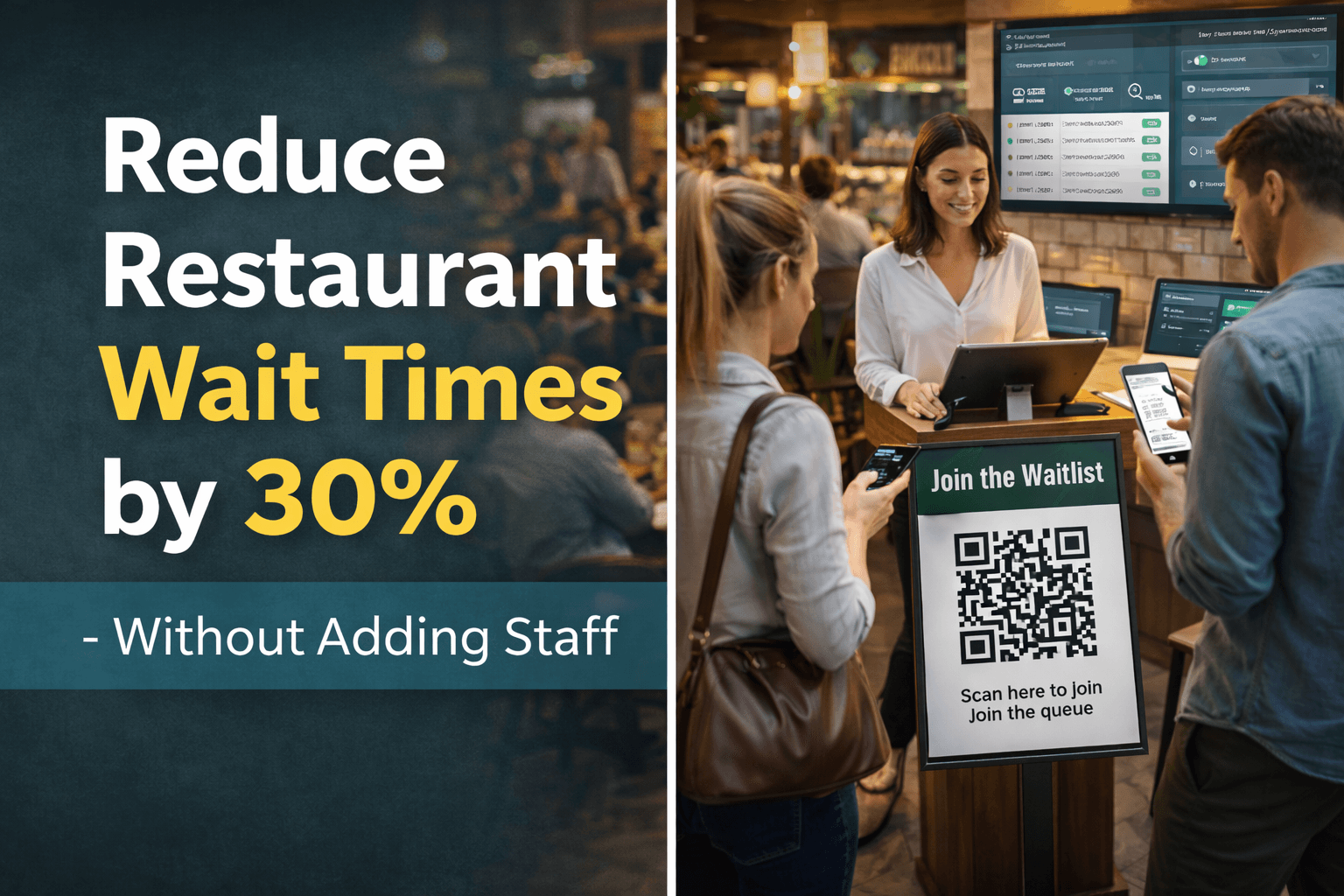
Virtual queuing eliminates this entirely. ScanQueue, for example, lets guests join from a QR code at the door with no app, captures their party size, and texts them when their table is ready.
How Virtual Queuing Works
- Customer joins your waitlist (via QR code, web, or staff assistance)
- Customer receives confirmation with their queue position
- Customer can wait anywhere—the bar, nearby shops, their car
- System sends SMS notification when their table is approaching
- Customer returns and is seated promptly
Why It Reduces Wait Times
Virtual queuing doesn't magically make tables turn faster—but it transforms the perception and management of wait times.
Perceived wait time reduction:
- Removing the "standing and staring" experience dramatically improves satisfaction
- Customers arrive relaxed and ready to enjoy their meal
Actual operational benefits:
- Reduced crowding at entrance (staff aren't managing a physical queue)
- Better table planning (you know exactly who's coming and party sizes)
- Fewer no-shows (customers don't "lose" their spot by stepping away)
- Staff freed from queue management to focus on turning tables
Strategy 2: Use Real-Time Analytics
You can't improve what you can't measure. Real-time analytics give you visibility into your queue performance and help you make smarter decisions.
Key Metrics to Track
1. Average Wait Time
How long customers actually wait from check-in to seating.
2. Wait Time Accuracy
How accurate are your quoted wait times vs. actual?
3. Walk-Away Rate
What percentage of customers leave before being seated?
4. Peak Time Patterns
When are your busiest periods?
How Analytics Reduce Wait Times
Predictive staffing:
When you know Friday 7pm is your peak, you can ensure you're fully prepared—pre-set tables, full host coverage, kitchen ready.
Optimised table allocation:
Analytics reveal whether you're efficiently using your floor. Are 2-tops sitting empty while 4-person parties wait? Adjust your allocation.
Quote accuracy:
When you know your actual wait times by party size and time of day, you can quote accurately—reducing frustration and walk-aways.
Strategy 3: Smart SMS Notifications
The way you notify customers has a massive impact on your efficiency. Get it wrong, and you're chasing people around, holding tables empty, and watching your wait times climb.
Get it right, and customers appear exactly when you need them.
Timing Your Notifications Perfectly
| Average Distance | Notify Before Table Ready |
|---|---|
| Customers waiting on-site | 1-2 minutes |
| Customers at nearby bar/shop | 5-7 minutes |
| Customers exploring area | 10-12 minutes |
Two-Way SMS: The Secret Weapon
Enable customers to respond:
- "DELAY" — Customer needs more time (add 10 minutes)
- "CANCEL" — Customer removes themselves from queue
- "COMING" — Customer confirms they're on their way
Strategy 4: Streamline the Check-In Process
The moment a customer decides to join your waitlist should take seconds, not minutes.
ROI Calculator: Time Saved = Revenue Gained
Calculate Your Losses
Current annual loss from walk-aways:
5 walk-aways × $80 × 6 days × 52 weeks = $124,800/year
If you reduce walk-aways by 50%:
Recovered revenue: $62,400/year
Calculate Your ROI
ROI = ($62,400 - $2,988) / $2,988 × 100 = 1,988%
For every $1 spent on queue management, you recover nearly $21 in previously lost revenue.
Implementation Checklist
Week 1: Foundation
- ☐ Sign up for a queue management platform
- ☐ Configure your account settings
- ☐ Create SMS notification templates
- ☐ Generate and print QR code signage
- ☐ Train front-of-house staff
Week 2: Soft Launch
- ☐ Display QR codes at entrance
- ☐ Run new system alongside existing method
- ☐ Gather staff feedback daily
Week 3: Full Implementation
- ☐ Make QR check-in the primary method
- ☐ Monitor queue analytics daily
- ☐ Adjust SMS notification timing as needed
Week 4+: Optimisation
- ☐ Review weekly analytics
- ☐ Fine-tune wait time estimates
- ☐ Survey customers on their experience
ScanQueue: a walk-in waitlist that frees up your host
ScanQueue is a virtual waitlist built for walk-in restaurants and cafes. Guests scan a QR code, enter their name and party size, and follow their place in line on their phone, then get an SMS or WhatsApp message when their table is ready.
- Less host work: no clipboard, no calling names across the room, and fewer "how long?" questions, because guests can see their own wait.
- No hardware: hosts run the list from any phone or tablet, and a TV display can show who is next.
- Data for the peaks: reports show daily volumes and wait times, so you can plan the busy sittings with the staff you have.
- Free to start: the Starter plan is free for up to 10 parties a day.
It is a waitlist, not a reservation system: if most of your covers are booked in advance, pair it with your booking tool rather than replacing it.
Conclusion: Shorter Waits Without More Staff
Shorter wait times are an achievable goal with the right process and available technology.
The four strategies we've covered work together:
- Virtual queuing transforms the waiting experience
- Real-time analytics give you visibility and control
- Smart SMS notifications eliminate dead time and no-shows
- Streamlined check-in removes friction from the first moment
Together, they can deliver:
- Significant improvement in customer satisfaction
- Meaningful increase in revenue
Built for Restaurants
See how ScanQueue helps restaurants reduce wait times without adding staff. Real support, transparent pricing, SMS included.
View Restaurant Solutions →Ready to Cut Your Wait Times?
Start Your Free ScanQueue Trial →✓ Set up in 5 minutes
✓ No hardware required
✓ No credit card needed
✓ Full support
Last updated: January 2026
Run a restaurant or cafe? See our restaurant waitlist app.
Stop losing walk-ins to wait times
Set up ScanQueue in 5 minutes. Customers scan a QR code, get SMS alerts when it's their turn, and wait anywhere.
- Free plan, no credit card
- No app download for customers
- QR code, SMS, and WhatsApp notifications
Fernando Mendes
Founder, ScanQueue
Helping businesses reduce wait times and improve customer experience with smart queue management solutions.