Most barber shops do not fail because the barbers cannot cut. They fail because five specific revenue leaks go unmeasured for years — until the rent bill arrives and there is nothing left to pay it with. These leaks look small day-to-day. In aggregate, they kill businesses that should be thriving.
This is not a "work harder" piece. Every successful shop we work with has the same realization at some point: the problem is not the craft, it is the operation. Below are the five silent killers, the math behind each, and the fix that takes minutes to implement.
U.S. Bureau of Labor Statistics data shows that roughly half of all new businesses close within five years.
The five silent revenue killers, at a glance:
- Unmeasured walkouts: customers who see the shop is busy and leave without joining the queue, costing roughly $28,000 to $47,000 a year.
- No-show appointments: empty booked slots, about $34,000 a year in the 3-chair example below.
- Idle chairs during peak hours: dead chair time between cuts, up to $81,000 a year in lost capacity in the example below.
- Unclear wait expectations: uncertainty that makes the wait feel longer than it is, driving early walkouts and bad reviews.
- Paper sign-in sheets: lost staff time, lost customer data, and entry errors, around $7,500 a year per location.
Killer #1: Unmeasured Walkouts
This is the biggest one, and it is almost always invisible. A walkout happens when a customer walks in, sees the shop is busy, and leaves without joining the queue. You never get their name. You never know they existed. You just know the shop was busy.
The math: Industry data from ScanQueue's own 4,400+ queue entries across multiple shops shows the average barber shop loses 3-5 walk-in customers per day when there is no wait-time visibility. At an average ticket of $30, that is $90-150 per day, $540-900 per week, $28,000-47,000 per year — for a single-location shop.
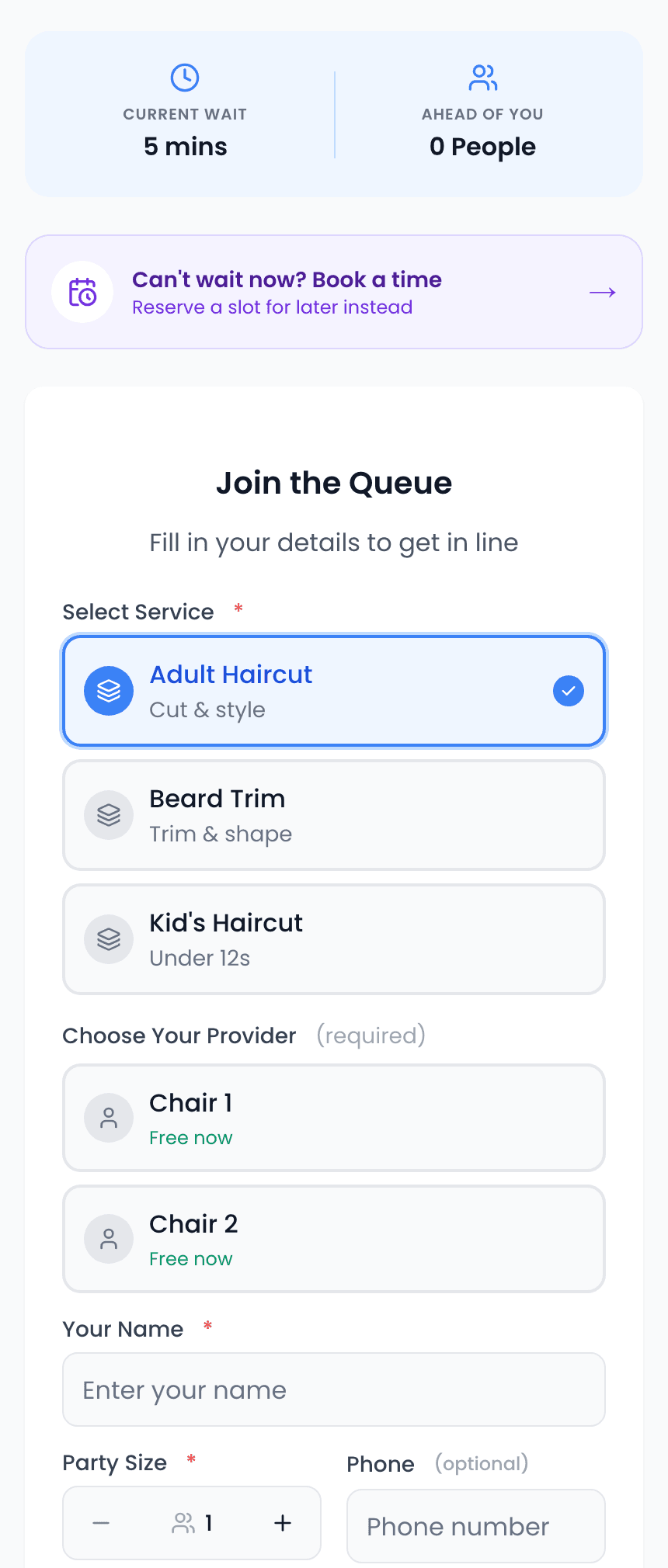
The fix: Show the wait before they commit to standing there. A QR code at the door that lets customers see the current queue and ETA — then join from their car, the coffee shop next door, or home — gives would-be walkouts a reason to stay. They still wait the same time, but they do it somewhere comfortable instead of leaving.
See a step-by-step guide to managing walk-ins without losing them.
Killer #2: No-Show Appointments
Shops that run appointments lose booked slots to no-shows. For a barber with 40 appointments a week, every no-show is an empty chair.
The math: 5 no-shows per week × $45 average appointment ticket × 50 weeks = $11,250 per year, per barber. A 3-barber shop: roughly $34,000 in annual no-show losses.
The causes are almost always the same: customer forgot, got busy, or assumed they could reschedule easily. Almost never malicious.
The fix: Three changes cut no-shows:
- SMS confirmations 24 hours in advance with a one-tap "Confirm" or "Reschedule" button.
- Smart rebook — when someone cancels, automatically offer the slot to the next customer in the queue. Empty chairs fill themselves.
- Cancellation policy with card-hold on repeat no-shows — first no-show free, second requires $10 deposit. Behavioral change happens fast.
Killer #3: Idle Chairs During Peak Hours
This one is counter-intuitive. A shop can be "busy" — meaning barbers are cutting — while simultaneously running well below capacity because chairs sit idle between clients.
The culprit: transition time. A customer finishes, pays, chats briefly, walks out. Then the next customer has to be located, walk over, get seated. If that transition takes 4-7 minutes per cut, then in a 3-barber shop cutting 40 clients a day, that is 160-280 minutes of dead chair time daily — 2.5-4.5 hours of lost revenue.
The math: If you could reclaim just half of that transition time, you fit 2-3 extra cuts a day per barber. At $30/cut × 3 cuts × 3 barbers × 300 days = $81,000 per year in recovered capacity.
The fix: Notify the next customer 5 minutes before the current cut finishes. They walk in just as the chair clears. No more "let me go find Marcus, he said he was next."
Killer #4: Unclear Wait Expectations
When a customer asks "how long is the wait?" and the answer is "maybe 20 minutes, maybe 45," you have already lost trust before the cut even starts. Unclear waits do two things, both expensive:
- They cause early walkouts — customers bail within 10 minutes of joining because the uncertainty feels worse than the time itself.
- They generate bad reviews — "Said 30 minutes, waited 90" is a common complaint in low-star barber reviews. Trust killed by inaccurate estimates.
The psychology: David Maister's classic essay The Psychology of Waiting Lines sets out the principle that uncertain waits feel longer than known, finite waits. A 20-minute wait with a known ETA is far easier to sit through than a 20-minute wait with no ETA.
The fix: Show a live ETA that updates as the queue moves. Customers handle a 30-minute wait easily if they can see the progress. They cannot handle 10 minutes of uncertainty.
Killer #5: Paper Sign-In Sheets
A clipboard by the front door feels charming. It is also costing you money in ways most owners never calculate.
What paper costs you:
- Staff time — time every day answering "where am I on the list?" and "how much longer?"
- Data loss — every piece of customer information (name, phone, service) disappears at end of day. No retargeting. No recovery. No marketing list.
- Errors — wrong phone numbers, illegible handwriting, missed entries.
- Skipped customers — when a barber calls the next name and they have wandered off, paper systems skip them. Digital queues send an SMS.
The math: If each paper-related issue costs you 1 customer per week at $30 per cut × 50 weeks = $1,500 per year per location just from paper inefficiency. The staff time alone (1 hour/day × $20/hr × 300 days) is $6,000 per year in receptionist cost you could avoid.
The fix: A QR code that customers scan to join themselves. No clipboard, no receptionist workload, and every entry is captured in your system for SMS, data analysis, and retargeting.
Read the full guide on moving from paper to digital queues.
The Total Cost of Doing Nothing
Add up the five killers for a typical 3-chair barber shop:
| Silent Killer | Annual Cost (3-chair shop) |
|---|---|
| Unmeasured walkouts | $28,000 - $47,000 |
| No-show appointments | $34,000 |
| Idle chair transition time | $40,000 - $81,000 |
| Paper sign-in inefficiency | $7,500 |
| Total annual leak | $109,500 - $169,500 |
These are rough estimates built from the example numbers above, not measured averages, but they show how quickly small leaks add up.
Why Most Owners Never Fix This
The five killers share a pattern: they are all invisible without measurement. A walkout is silent. A no-show is a blank slot. An idle chair looks like a break. An unclear wait is just "the way it is." A paper clipboard is normal.
Owners do not fix what they cannot see. The first week of running any queue system with data exposes problems that have been costing money for years. That is uncomfortable — and it is also the fastest path to a more profitable shop.
The 30-Day Turnaround
If you have read this far and recognize your shop in these numbers, the good news is the fix is fast. Here is what the first 30 days look like for most shops that switch:
- Week 1: QR code at the door, first customer joins from their phone. Walkouts start getting measured.
- Week 2: SMS confirmations live for appointments. No-show rate drops measurably.
- Week 3: Staff stop answering "how long is the wait?" — customers see it themselves.
- Week 4: First data report comes in. You see exactly how many walkouts you had, which hours are your highest-leak, which services have the worst no-show rate.
None of this requires you to work harder. It requires your shop to measure and communicate — things a queue system does automatically.
FAQ
What percentage of barber shops actually fail?
U.S. Bureau of Labor Statistics data shows roughly 20% of new businesses close within the first year and around half within five years. Those figures cover all industries, not barber shops specifically.
What is the single biggest revenue killer?
Walkouts. A 3-chair shop loses an estimated $28,000-47,000 annually to customers who arrive, see a wait, and leave without being served.
How do I know if I have a walkout problem?
If you are busy but not growing, you probably have one. Regulars mentioning "I tried to come in but you were slammed" is a reliable signal.
Are appointment-only shops more profitable?
Not necessarily. Appointment-only shops carry no-show risk, and many barber clients still prefer to walk in. Running both in one queue lets a shop serve both.
Can a small barber shop afford queue management software?
Yes. Modern systems run $0-99/month and typically pay back the cost with a single saved customer per day.
Find out what your shop is leaking.
Start with a free ScanQueue account. QR code at the door, SMS notifications, real data on walkouts and no-shows. Live in under 5 minutes.
Start Free Barber Shop Queue GuideLast updated: April 2026
Stop losing walk-ins to wait times
Set up ScanQueue in 5 minutes. Customers scan a QR code, get SMS alerts when it's their turn, and wait anywhere.
- Free plan — no credit card
- No app download for customers
- QR code, SMS, and WhatsApp notifications
ScanQueue Team
Queue Management Experts
Helping businesses reduce wait times and improve customer experience with smart queue management solutions.