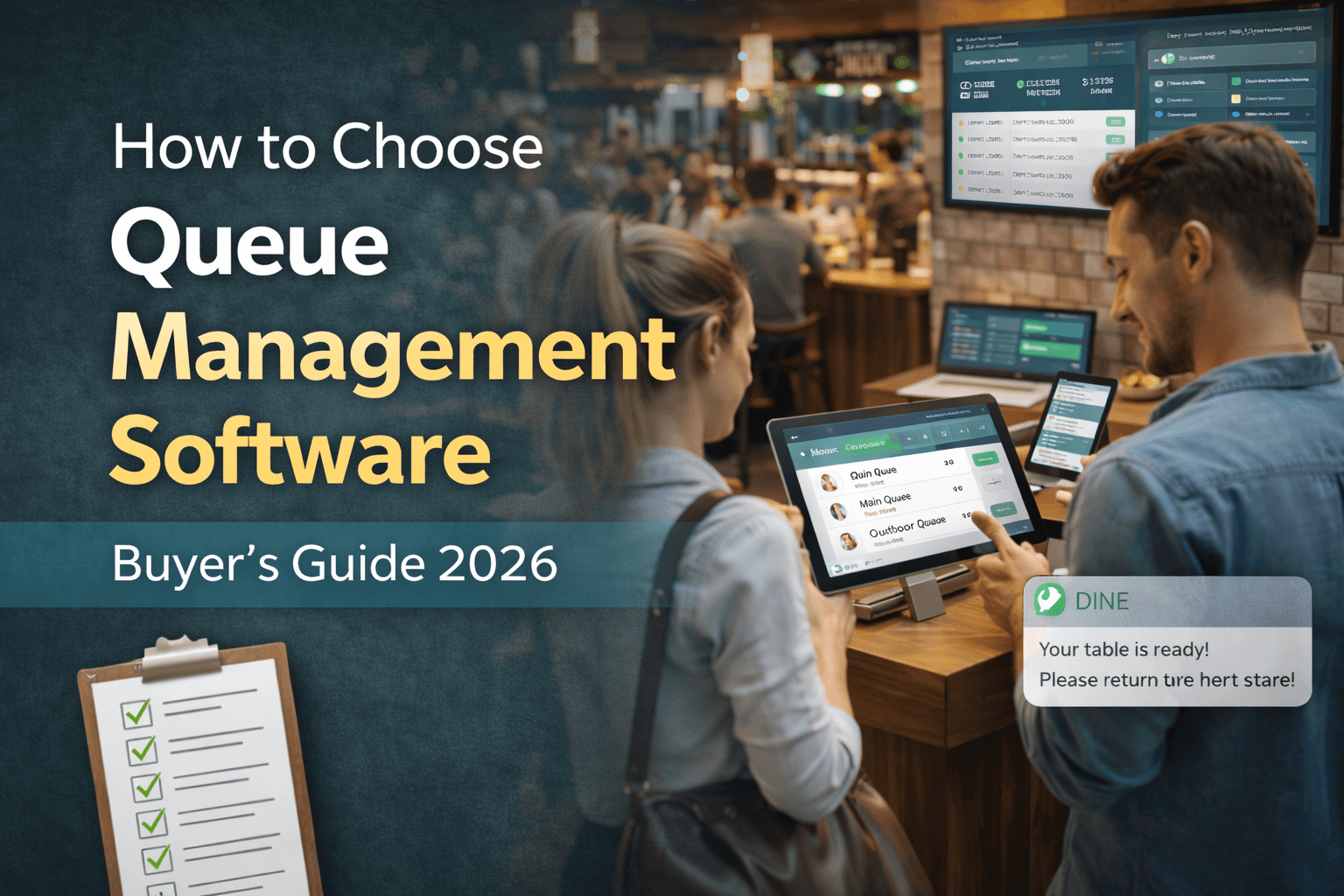
There is no single tool that fixes wait times. The businesses that consistently serve customers faster during peak hours run a stack of complementary technologies, each addressing a different layer of the problem. The headline tool (queue management software) tends to get most of the attention, but it works best when paired with demand forecasting, intelligent staff scheduling, self-service capture, and AI-driven triage.
This guide covers the six categories of technology that meaningfully reduce real or perceived customer wait times in 2026, the evidence on their impact, and how to combine them. The audience is operators in restaurants, clinics, banks, retail, and government service centres. Each category links to a relevant queue management system capability or industry solution.
The Wait Time Problem in 2026
Forrester's customer service research found that 73% of consumers say "valuing my time" is the most important thing a business can do for them.
The cost of long waits is well documented. A 2018 Adyen survey run by 451 Research estimated that US retailers lost $37.7 billion in potential sales over 12 months because shoppers left long lines. Grand View Research projects the queue management system market to reach USD 1.22 billion by 2030, growing at a 6.4% CAGR.
The interesting research finding is that perceived wait time is more important than actual wait time. A study by David Maister at Harvard Business School established that occupied time feels shorter than unoccupied time, that uncertain waits feel longer than known waits, and that unexplained waits feel longer than explained waits. Almost every effective wait-time tool exploits one of these three principles.
1. Queue Management Software
The foundation of the stack. A virtual queue replaces the physical line: customers scan a QR code, join a queue from their phone, and receive an SMS when their position is called. They can wait wherever they choose. ScanQueue, for example, lets customers join by QR code with no app download and texts them when they are next.
The mechanism for reduced wait time is twofold. First, perceived wait drops dramatically because customers spend the wait doing something else (browsing, having a coffee, sitting in their car) rather than standing in line. Second, the data the platform produces lets operators identify staffing gaps and adjust before the next peak. Used in restaurants, clinics, and bank branches.
2. Demand Forecasting
Demand forecasting predicts how many customers will arrive in each 15 or 30 minute window across the day, based on historical data, weather, local events, and seasonality. The output feeds staff scheduling, inventory planning, and queue capacity decisions.
The mechanism for reduced wait time is upstream. If you know that next Saturday at 1 pm will see 40% more arrivals than the rolling Saturday average, you can roster an extra staff member rather than discovering the problem mid-rush. Modern forecasting tools (Workforce.com, Deputy AI Insights, Square's analytics, custom-built dashboards using historical queue data) can do this from historical patterns.
3. Staff Scheduling Software
Staff scheduling tools (Deputy, When I Work, Homebase, 7shifts) let managers build rosters that match forecast demand. The newer generation includes auto-scheduling that proposes shift patterns from forecast inputs, real-time labour-cost tracking, and integration with queue platforms so that "actual customer arrivals" can be compared with "scheduled staff" in retrospect.
The mechanism for reduced wait is matching capacity to demand at the half-hour level. The 11 am to 1 pm restaurant rush requires roughly 2x the front-of-house staff of 3 pm to 5 pm. Without scheduling software, operators tend to over-staff one shift and under-staff the other.
4. Self-Service Kiosks and Tablets
Self-service capture lets customers complete simple tasks without staff: ordering at a fast-casual restaurant, checking in at a clinic, choosing a service category at a bank or council branch. The customer's time-to-served is shorter because they bypass the staff bottleneck for routine work.
The mechanism is throughput. A clinic that lets patients self-check in via a tablet frees the receptionist to handle exceptions (insurance issues, clinical questions) and increases the number of patients processed per hour. McDonald's has reported that customers using self-order kiosks tend to spend more (because they take more time to browse) but also process faster from a queue-management perspective because the order capture step happens in parallel with payment instead of sequentially.
5. Mobile Ordering and Pre-Arrival Capture
Mobile ordering lets customers place orders or join queues before they arrive. Common in coffee chains, casual restaurants, click-and-collect retail, and increasingly in government service centres where citizens can join the queue from a council website.
The mechanism is shifting work out of the peak window. A coffee customer who pre-orders at 8:35 for an 8:45 pickup does not stand in the 8:45 queue at all. The store still serves the same number of drinks per hour but has more queue-time slack for in-store walk-ups.
6. AI Receptionists and Voice Triage
AI receptionists answer phone calls and chat enquiries, capture customer details, and route the customer into the right queue or appointment slot without staff intervention. They are particularly impactful for clinics, salons, restaurants taking reservations, and small businesses where every staff phone interruption costs in-person service time.
The mechanism is removing phone interruptions from frontline staff. A receptionist who handles 30 phone calls during a peak shift loses 30 to 60 minutes of in-person service capacity. AI receptionists handle the routine calls (booking, rescheduling, hours, directions) and only escalate exceptions to a human.
Comparison of Approaches
The six categories address wait time from different angles. The right combination depends on your industry, peak pattern, and current bottleneck.
| Tool Category | Targets | Setup Effort | Best For |
|---|---|---|---|
| Queue management | Perceived wait | Low (minutes) | All walk-in businesses |
| Demand forecasting | Capacity planning | Medium | Mid-size and up |
| Staff scheduling | Capacity timing | Low to medium | Hospitality, retail |
| Self-service kiosks | Throughput | Medium to high | QSR, clinics, banks |
| Mobile ordering | Peak shifting | Medium | Coffee, QSR, retail |
| AI receptionist | Staff distraction | Low | Clinics, salons |
How to Combine These Tools
The order of operations matters. Most operators get the biggest single gain from queue management software because it produces the data that the rest of the stack depends on. The recommended sequence is:
- Start with queue management. The data it generates feeds every other tool. The setup cost is the lowest in the stack.
- Layer staff scheduling on top. Use the queue data to align rosters with actual demand patterns. Most scheduling tools accept CSV imports.
- Add forecasting once you have 90 days of queue data. Forecasting needs historical data to be useful. Without it, it is guessing.
- Introduce self-service for routine work. Identify which tasks could happen without staff and migrate them.
- Add mobile ordering or pre-arrival flow. Especially valuable for businesses with strong peak concentration.
- Deploy AI receptionist to remove phone interruptions. Particularly impactful in clinics and salons.
Evidence on Real-World Impact
A few studies worth knowing if you are making the case to a finance team or board:
- Maister, Harvard Business School. The Psychology of Waiting Lines. Established the principle that perceived wait is the dominant variable in customer satisfaction, not actual wait.
- Forrester customer service research. 73% of consumers cite "valuing my time" as the top customer service priority.
- Adyen and 451 Research, 2018. US retailers lost an estimated $37.7 billion in potential sales over 12 months to shoppers who left long lines.
- Grand View Research. Queue management system market projected to reach USD 1.22 billion by 2030 at a 6.4% CAGR.
- J.D. Power and Cornell Center for Hospitality Research. Check-in completed within five minutes is one of the key performance indicators linked to top hotel guest satisfaction ratings.
ScanQueue: virtual queue, SMS updates and live wait times in one tool
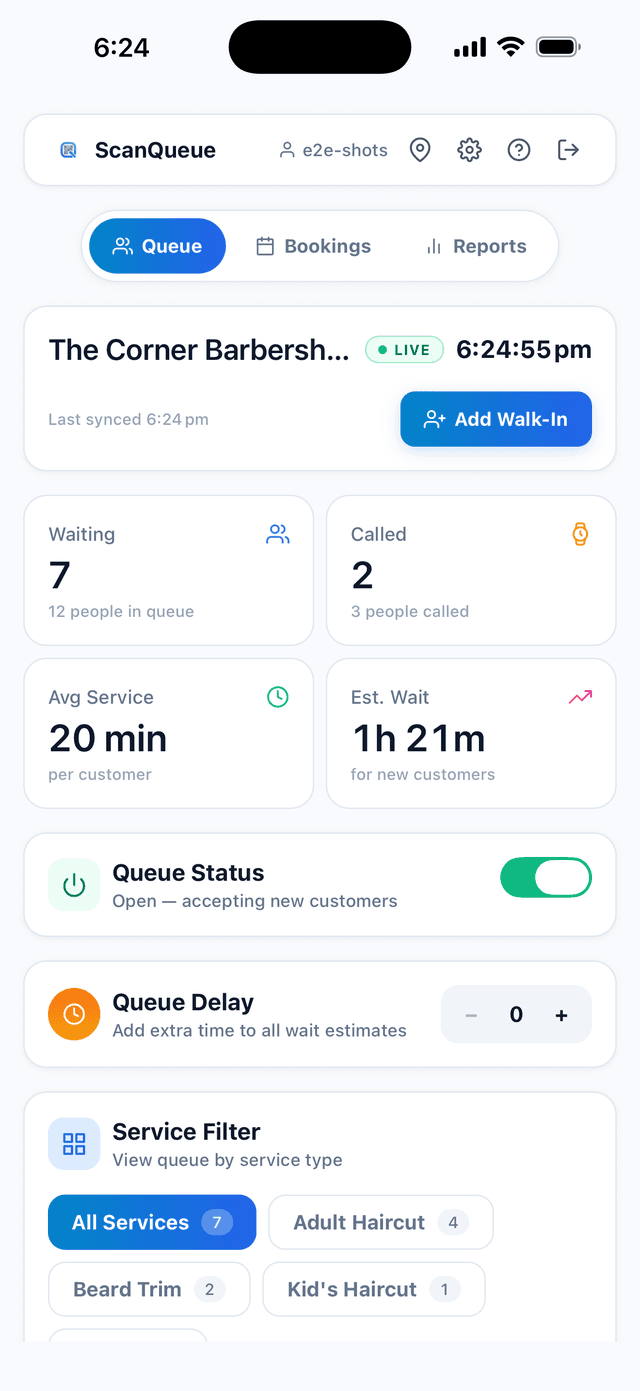
ScanQueue is queue management software built around the first category in this guide, and it covers parts of three others. Customers scan a QR code and join from their phone with no app download, see their place in line and an estimated wait, and get an SMS or WhatsApp message when they are next.
- Queue management: walk-ins and booked appointments in one list, with separate queues per service and staff dashboards on any device.
- Self-service check-in: a kiosk mode turns any tablet into a check-in point, so there is no hardware to buy.
- Wait-time display: a TV display shows who is being called and how long the wait is, which removes the uncertainty Maister identified.
- Mobile ordering: on Growth plans and above, guests can order and pay from their phone through Square.
It does not replace staff scheduling or demand forecasting software, but its reports on daily volumes and wait times are the input those tools need. The Starter plan is free for up to 100 queue joins a month.
Frequently Asked Questions
What is the single most effective tool for reducing wait times?
Queue management software, specifically the kind that lets customers join a queue from their phone and receive SMS callbacks.
Why does perceived wait time matter more than actual wait time?
Customers judge their experience by how the wait felt, not how many minutes it took. A 15-minute wait spent browsing or sitting at a coffee shop feels shorter than an 8-minute wait spent standing in line.
Do small businesses need all six tool categories?
No. Most small businesses get most of the benefit from queue management plus simple staff scheduling. The other categories matter more as volume and complexity grow.
How much does a queue management system cost?
Cloud-based platforms range from free starter plans to over $1,000 per month for paid tiers (Qminder Premium is $1,149 per month). Enterprise hardware-led systems are usually quoted per location.
Are AI receptionists reliable enough to use on real customer calls?
The 2026 generation of conversational AI can handle routine bookings, rescheduling, and FAQs. Set them up to escalate cleanly to a human for anything outside the routine path.
Which industries benefit most from this stack?
Restaurants, clinics, salons, retail, banks, and government service centres see the biggest gains because their wait times directly affect customer satisfaction and revenue. Industries with non-discretionary demand (council services, healthcare) particularly benefit from the data side of the stack.
Start with the foundation
Queue management is the highest-leverage tool in the stack. ScanQueue is free to start, runs without hardware, and produces the data the rest of your tooling needs.
Try ScanQueue freeStop losing walk-ins to wait times
Set up ScanQueue in 5 minutes. Customers scan a QR code, get SMS alerts when it's their turn, and wait anywhere.
- Free plan, no credit card
- No app download for customers
- QR code, SMS, and WhatsApp notifications
Fernando Mendes
Founder, ScanQueue
Helping businesses reduce wait times and improve customer experience with smart queue management solutions.