Ask most barbershop owners about walk-ins and you will hear some version of the same worry: they are unpredictable, they clog the shop, and half of them wander off before you can get to them. It is the reason a lot of shops drift toward appointment-only.
We were able to test that belief against real data. ScanQueue runs the digital walk-in queue for hundreds of businesses, so we pulled every barbershop visit from one clean month: 879 walk-in queue visits across 18 barbershops in May 2026, including a few shops that have since cancelled. No survey, no projections, just what customers actually did.
The data quietly demolished the worry. Here is what we learned.
The headline numbers
879 walk-in visits analysed across 18 barbershops
82% served, and 99% served once called
12% cancelled by the customer
~2% no-show
24 min median wait from joining to being called
~1h 45m the longest 10% of waits (90th percentile)
Lesson 1: Walk-ins show up. Almost all of them.
The number that stopped me was the no-show rate: about 2%, just 18 visits out of 879. Appointment-based businesses, from clinics to salons, routinely fight no-show rates of 10% to 30% (a systematic review of the research puts the average near 23%). The walk-in model, the one owners worry about, had a fraction of that.
It makes sense once you think about the structure. An appointment is a promise made days in advance, when life looked different. A walk-in is a decision made right now, in the moment the customer actually wants a cut. They are already warm. Add a queue they can watch from their phone and a notification before their turn, and there is almost no gap for a no-show to slip into. Low friction to join produces high follow-through.
The practical implication: if a vendor is selling you queue software on the promise of "reducing no-shows," they are solving a problem you do not really have. The real leak is upstream, and it is the next lesson.
Lesson 2: The real enemy is the silent walk-out, not the cancel
About 12% of customers cancelled. That number can look like a problem. It is the opposite.
When someone taps cancel, you learn three things instantly: a customer was interested, the wait was too long for them today, and they are gone. Compare that to the shop with a paper list and a crowd by the door, where the same customer simply leaves and you never know they existed. A cancel is honest, real-time feedback. A silent walk-out is invisible lost revenue.
So I would not chase a 0% cancel rate. A 0% cancel rate usually means one of two things: your waits are so short nobody ever needs to leave (great, and rare on a Saturday), or you have no digital queue and people are walking out without a trace (the expensive version). The 12% is the sound of a queue working as a feedback instrument.
Lesson 3: A typical wait is 24 minutes, and that is fine if you say so
The median customer waited 24 minutes. 39% were in the chair within 15 minutes, 59% within half an hour, and 80% within the hour. The longest 10% stretched to nearly two hours on peak weekend afternoons.
Here is the thing about 24 minutes: it is completely acceptable to a customer who knows about it, and infuriating to one who does not. A widely cited survey of UK shoppers for Box Technologies and Intel found people will stand in a store queue for about nine minutes on average before leaving empty-handed. Give them a live position and an estimate and they can spend the wait somewhere else. The wait did not change. The information did. That gap, between standing blind in a line and knowing where you stand, is the entire value of a queue system for a barbershop.
Lesson 4: The week is really two days
Saturday was nearly three times busier than Monday, and Friday plus Saturday alone made up 41% of the entire week. Weekend waits also ran about 60% longer: a 32 minute median versus 20 minutes midweek. The busiest single shop pushed 52 walk-ins through in one day.
This reframes what queue management is for in a barbershop. It is not an all-day, all-week system you babysit. It is a tool that earns its entire value in a roughly two-day window, when the line is long enough to cost you customers and the front desk is too busy to track everyone by name. If you are going to add a barber for a few shifts, the data points squarely at the weekend.
Lesson 5: The line itself is the cancel button
Here is the single most useful pattern in the data. Whether a customer cancels has almost nothing to do with who they are, and almost everything to do with how long the line is when they join.
Joined with 0 to 2 ahead: only 8% cancelled
Joined with 3 to 5 ahead: 17% cancelled
Joined with 6 or more ahead: around 70% cancelled
Cancellation roughly doubles once the line passes a couple of people, then falls off a cliff beyond five or six deep. (That deepest bucket is a small share of visits, so I read it as a strong direction rather than a precise number.) And people do not bail in a huff the second they join. The median cancellation came after 37 minutes of waiting, with most happening past the half-hour mark. Customers give a long line a genuine chance, then quietly decide it is not worth it.
The flip side is the most reassuring number I found: once a customer was actually called, 99% were served. Nobody vanishes at the finish line. People drop out while the line is long and the wait is uncertain, never after their name is up. That tells you exactly where to spend effort. You do not need to chase people down at the end. You need to keep the front of the line moving and set expectations early, before a deepening queue makes the decision for them.
What I would do with this
Three things, if I owned a shop:
- Stop fearing walk-ins. A 2% no-show rate is the kind of reliability appointment businesses dream about. Lean into walk-ins, just give them a queue they can see.
- Staff the weekend, not the average. Two days carry 41% of your volume and your longest waits. Your scheduling should reflect that, not a flat week.
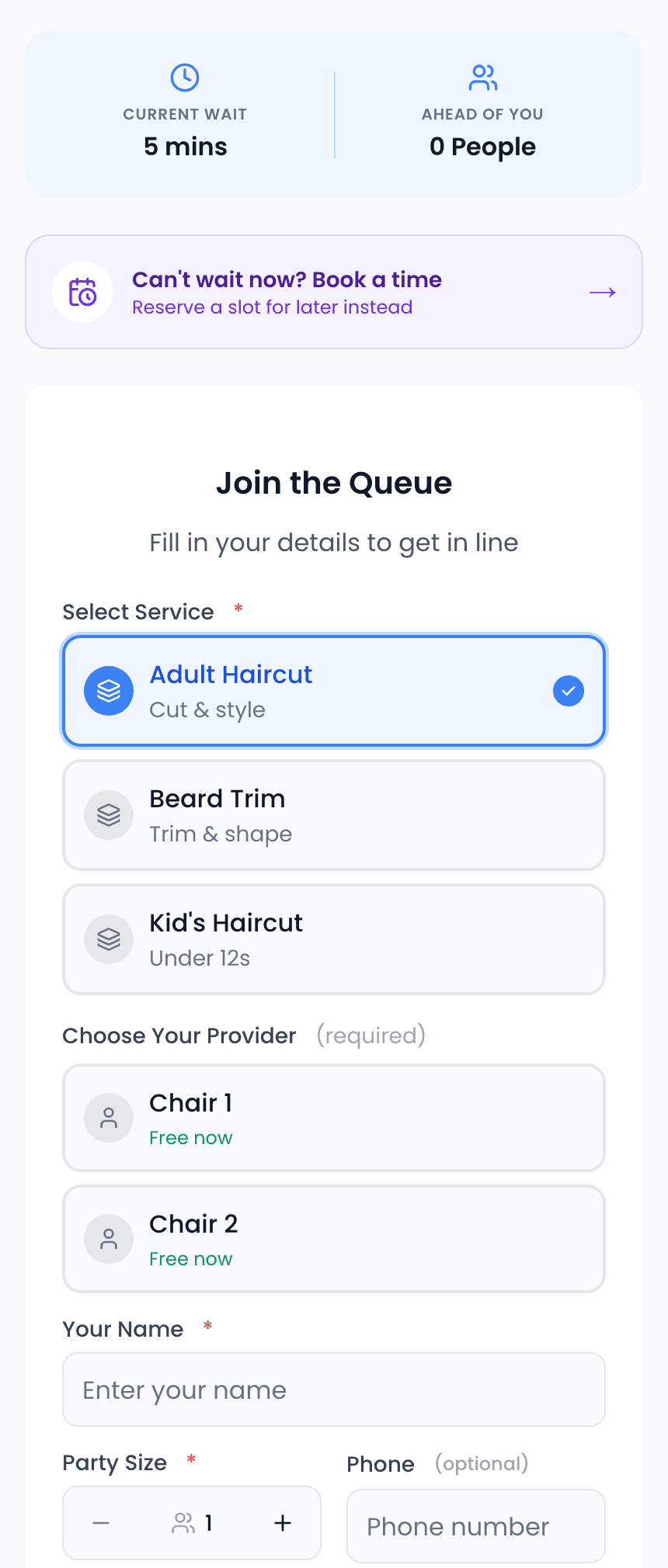
- Tell customers their wait. The single cheapest upgrade to your customer experience is showing people their position and texting them before their turn. It converts a frustrating wait into a planned one, and it is most of why so few people walked away.
Walk-ins are not the problem. Unmanaged walk-ins are. The shops in this data did not have more disciplined customers than yours. They just gave ordinary customers a way to wait that respected their time, and the customers rewarded them by showing up.
Run your own barbershop queue, free
No credit card. QR-code join, live position, a text when it is their turn. See how ScanQueue works for barbershops, or browse the full 19 barbershop wait time and no-show statistics.
Create Free Account →Data source: ScanQueue platform, 879 walk-in queue visits across 18 barbershops during May 2026, including shops that have since cancelled. Wait measured from queue join to being called. Figures are anonymised and aggregated; no individual shop is identified. The sample skews toward the United States.
Stop losing walk-ins to wait times
Set up ScanQueue in 5 minutes. Customers scan a QR code, get SMS alerts when it's their turn, and wait anywhere.
- Free plan — no credit card
- No app download for customers
- QR code, SMS, and WhatsApp notifications
Fernando Mendes
Founder, ScanQueue
Helping businesses reduce wait times and improve customer experience with smart queue management solutions.