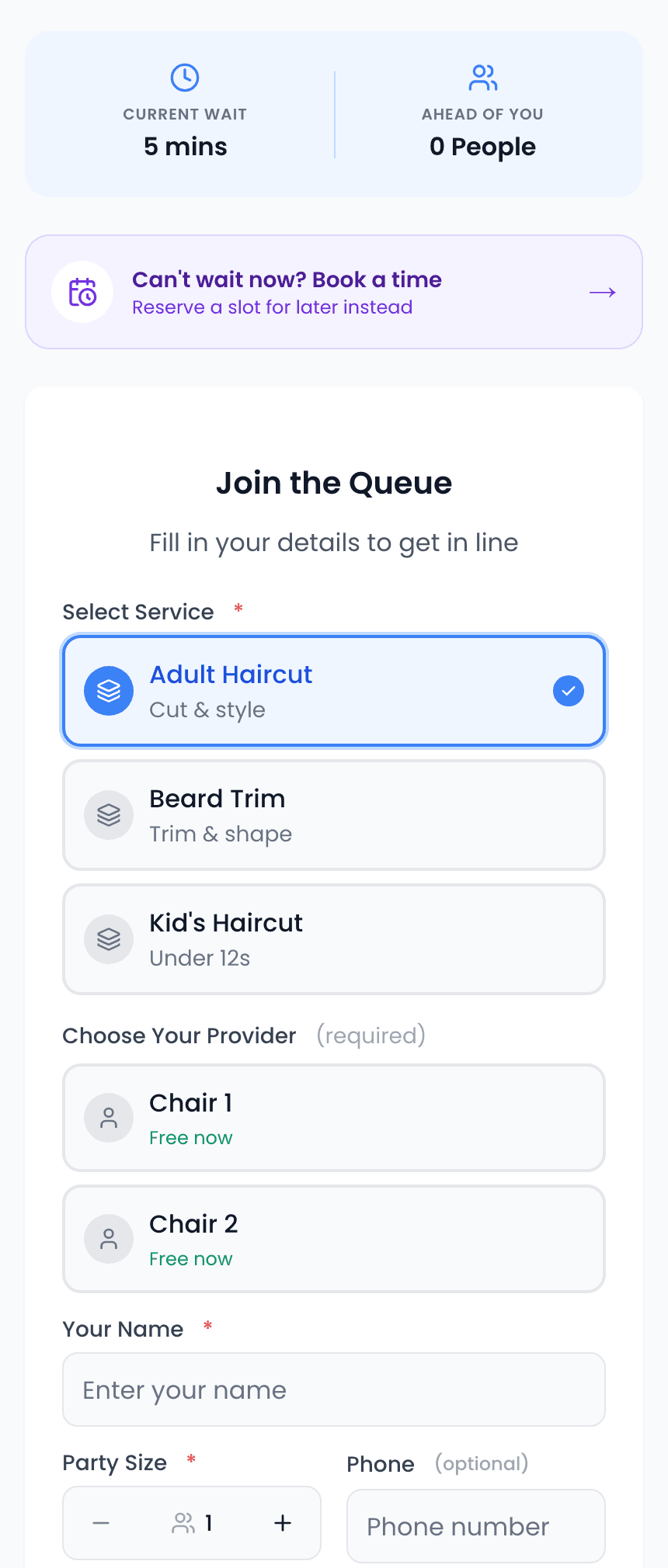
Most barbershop "statistics" you find online are guesses dressed up as research. We decided to do something different and open our own books. These numbers come from 879 real walk-in queue visits across 18 barbershops using ScanQueue during May 2026, including shops that have since cancelled. Every figure is computed live from actual customer queue entries, not a survey or a vendor whitepaper.
The headline finding is the one that surprises almost every owner we talk to: only about 2% of walk-in customers no-showed. The common belief is that walk-ins are messy, unreliable and hard to manage. The data says the opposite. When customers can join remotely, see their place in line and get a heads-up before their turn, they are far more predictable than most shops assume. Walk-ins are not the problem. Unmanaged walk-ins are the problem.
Here are 19 statistics from the data, starting with wait times and finishing with the numbers worth pinning to your wall.
Barbershop Wait Time Statistics
How long do barbershop customers actually wait, and how predictable is that wait? These six numbers come straight from the timestamps on real queue entries, measured from the moment a customer joins to the moment they are called.
1. The median barbershop wait is 24 minutes
Across all 879 visits, the median time from joining the queue to being called was 24 minutes. We report the median rather than the average on purpose. A handful of very long waits (a customer who joined and wandered off, a shop that left the queue open at closing) drag the average up and misrepresent what a typical client actually experiences. Twenty-four minutes is the honest number.
2. 39% of customers were seen within 15 minutes
Nearly four in ten walk-ins were in the chair within a quarter of an hour. For a walk-in business with no appointments, that is a fast turnaround, and it is invisible to the customer unless you tell them. A queue that shows "you are 2nd, about 12 minutes" turns a vague wait into a plan.
3. 59% were seen within 30 minutes
By the half-hour mark, well over half of all customers had been called. This is the sweet spot where transparency pays off most: a widely cited survey of UK shoppers for Box Technologies and Intel found people will stand in a store queue for about nine minutes on average before leaving, while customers who can see their position move are free to wait somewhere else.
4. 80% were seen within 1 hour
Four out of five customers were served inside 60 minutes. The point is not that an hour is short, it is that the wait is bounded and knowable. The 20% who waited longer were overwhelmingly weekend peak-hour visits.
5. The longest 10% of waits stretched to nearly 2 hours
The 90th percentile wait was about 1 hour 45 minutes. These are your Saturday-afternoon, every-chair-full moments. The customers who sat through them did so because they could wait from a cafe or their car instead of standing in a packed shop, which is exactly why they did not walk away.
6. Weekend waits run about 60% longer than weekdays
The weekend median wait was 32 minutes versus 20 minutes on weekdays. If you only staff for your weekday rhythm, your busiest customers get your slowest service. This single number is the strongest argument for an extra weekend barber.
Barbershop Reliability Statistics
Walk-in queues have a reputation for being chaotic and unreliable. The outcome data says the opposite. Here is how dependably barbershop customers actually follow through once they join.
7. Only ~2% of walk-ins no-showed
This is the headline. Just 18 of 879 visits ended as a no-show, roughly 1 in 50. Appointment-based businesses commonly report no-show rates in the 10% to 30% range (a systematic review of the research puts the average near 23%). Walk-in customers who chose their own moment to join, watched their place in line, and got a notification before their turn simply show up. The walk-in model is not the liability owners fear, it is an advantage.
8. Once a customer was called, 99% were served
The reliability number that matters most. Of every customer who was called to the chair, 98.8% were served. Disappearing after being called was almost nonexistent. Customers who cancel do it while waiting, not after their name comes up. Once you get to them, they are there.
9. 82% of customers who joined were served
More than four in five queue joins ended in a completed cut. The remaining fifth is not waste: it is honest signal about your capacity at peak times, which a paper list or a "just wait over there" never captures.
10. 12% cancelled, and that is healthy
About 12% of customers tapped cancel, usually after seeing a wait they did not want to sit through. Counterintuitively, a visible cancel rate is a good sign. The alternative is a silent walk-out where the customer leaves and you never know they were there. A cancel is a customer being honest with you in real time, and it lets you read your true demand. And they do not bail early: the median cancel came after 37 minutes of waiting, with 52% of cancels happening only after the 30-minute mark.
11. Cancellations climb sharply as the line gets longer
This is the operational insight every barber can act on. Cancellation rate depends almost entirely on how many people are already ahead when a customer joins:
| People ahead at join | Cancellation rate |
|---|---|
| 0 to 2 | 8% |
| 3 to 5 | 17% |
| 6 or more | 70% |
Customers were about twice as likely to cancel at positions 3 to 5, and the rate spikes once 6 or more people are ahead. (The 6-plus group is a small slice of visits, so read it as a strong directional signal rather than a precise figure.) The practical takeaway: when your line passes roughly five deep, that is the moment to add a chair, trim service time, or set expectations, because that is where you start bleeding customers.
12. Only 3% expired without ever being called
A mere 3% of entries expired (the queue closed or the entry aged out before the customer was reached). Combined with the low no-show rate, it means the overwhelming majority of joins reach a clear outcome: served, or a deliberate cancel. Very little simply falls through the cracks.
Barbershop Demand & Rhythm Statistics
A barbershop week is not flat. These numbers show when the work actually lands, and just how concentrated demand is into a handful of peak days.
13. Saturday is nearly 3x busier than Monday
Saturday was the single busiest day of the week by a wide margin, handling close to three times the walk-in volume of the quietest day, Monday. If you have ever felt your weekend was carrying the whole week, the data agrees with you.
14. Friday and Saturday alone were 41% of the week
Just two days accounted for 41% of all walk-in volume. Queue management is not an all-week, all-day tool for a barbershop. It earns its keep in a roughly two-day window, which is precisely when the line is long enough to cost you customers.
15. The busiest single shop processed 52 walk-ins in one day
On its peak day, the busiest barbershop in the dataset handled 52 walk-in visits. Managing 52 names, positions and notifications on paper or in your head is where mistakes, double-bookings and walk-outs happen.
16. The average active shop saw about 10 walk-ins per open day
Across active trading days, shops averaged roughly 9 to 10 walk-ins per day through the queue. Steady, predictable, and exactly the profile that makes a digital queue worth the two minutes it takes to set up.
17. 1 in 5 customers came back within the month
Even in a single month of data, 21% of customers returned for a second visit. Because this is just one month, it understates true loyalty (most men get a cut every 3 to 5 weeks). Barbershops live on repeat business, and a smooth first wait is what earns the second visit.
How Customers Join, and Time Managed
Two final numbers on the mechanics: how customers actually reached the queue, and how much collective waiting the system absorbed.
18. 99% of customers joined themselves by scanning a QR code
More than 99% of visits were customer self-check-ins from their own phone, not entries a staff member typed in at the counter. That is the whole point: the queue runs itself. Your barbers keep cutting while customers join, watch their position and wait wherever they like, with no front-desk data entry and no clipboard.
19. ScanQueue managed more than 500 customer-hours of waiting
Across the sample, ScanQueue managed over 500 customer-hours of barbershop waiting (roughly 520 hours from join to being called). Every one of those hours is time a customer spent informed, watching their place move, instead of standing in a doorway guessing. That is the difference between a wait that feels managed and one that feels endless.
The Industry Context
A few external numbers to frame the data above. The US barber shop industry is worth around $7 billion a year across roughly 155,000 shops (IBISWorld), and has been growing steadily, driven by a return to traditional men's grooming. It is a fundamentally walk-in trade: unlike salons, most barbershops do not run on rigid appointment books. That walk-in nature is exactly why the 2% no-show figure matters so much. The appointment world fights a 10% to 30% no-show problem; the walk-in world, managed well, barely has one.
The takeaway: Walk-ins are not unreliable. The data shows that when customers can join from their phone, see their place, and get notified before their turn, around 82% get served and only about 2% vanish. The job of queue software is not to tame chaotic customers. It is to give predictable customers a wait they can plan around.
Run your barbershop queue for free
No credit card. Customers scan a QR code, watch their place in line, and get a text when it is their turn. Set up in 5 minutes. See how it works for barbershops.
Start Free →Want the story behind the numbers? Read what 879 real barbershop visits taught us about walk-in wait times, or see how the same patterns play out when you manage barber walk-ins day to day.
Data source: ScanQueue platform, 879 walk-in queue visits across 18 barbershops during May 2026, including shops that have since cancelled. Wait measured from queue join to being called. Figures are anonymised and aggregated at the platform level; no individual shop is identified. The sample skews toward the United States.
Stop losing walk-ins to wait times
Set up ScanQueue in 5 minutes. Customers scan a QR code, get SMS alerts when it's their turn, and wait anywhere.
- Free plan — no credit card
- No app download for customers
- QR code, SMS, and WhatsApp notifications
ScanQueue Team
Queue Management Experts
Helping businesses reduce wait times and improve customer experience with smart queue management solutions.