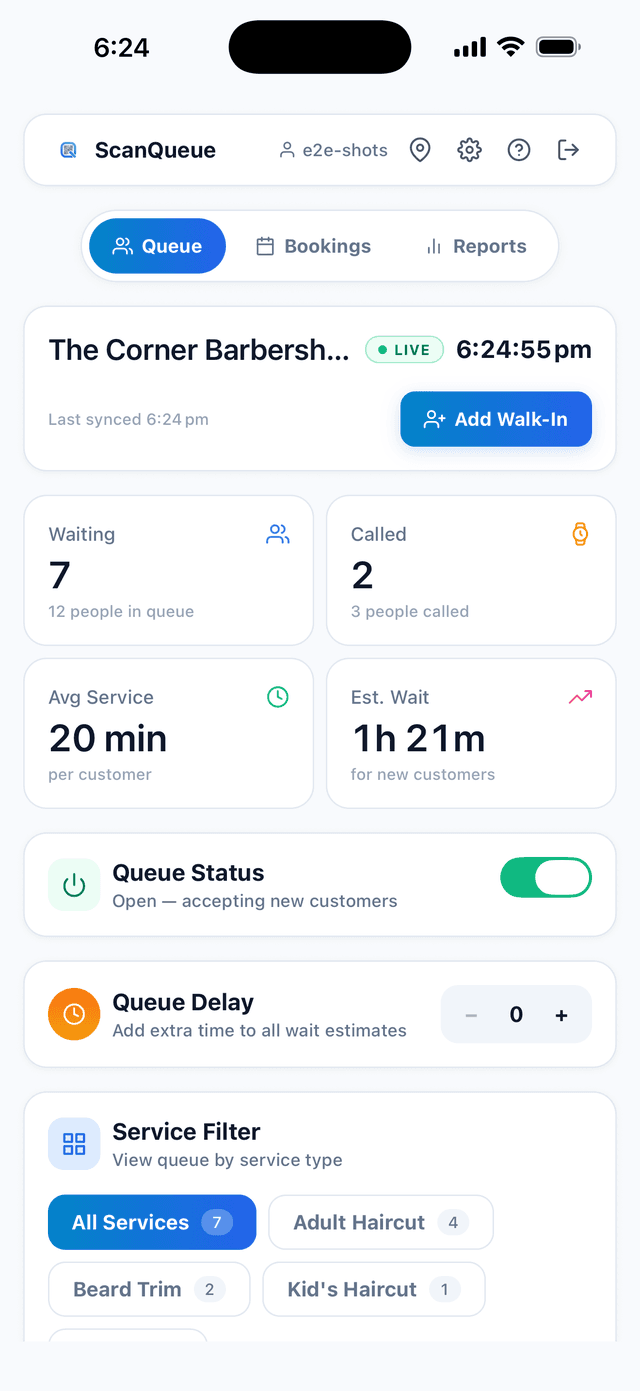
The single most effective way to reduce customer wait times is to implement a virtual queuing system, such as ScanQueue, that lets customers join a queue by QR code and wait remotely. But that's just one of ten proven strategies. This guide covers all of them — from technology solutions to operational changes — so you can pick what works for your business.
Long wait times are a business killer. Forrester research found that 73% of consumers say that valuing their time is the most important thing a company can do.
What tech tools help reduce wait times during busy service?
Three tools do most of the work during a rush: a virtual queue that customers join by QR code, SMS alerts that call them back when they are nearly up, and a live wait-time display so nobody has to ask how long. Together they let customers wait somewhere other than your counter, which matters because 73% of consumers say valuing their time is the most important thing a company can do (Forrester). Queue analytics and self-service check-in come next: analytics show where the bottlenecks are, and self check-in takes the sign-in step off your staff.
Here are 10 actionable strategies, ranked by impact.
1. Implement Virtual Queuing
Virtual queuing is the highest-impact change you can make. Instead of having customers stand in a physical line, they join via a QR code or link and wait from anywhere — their car, a nearby shop, or a bench outside. Tools like ScanQueue set this up in about 5 minutes: print a QR code, and customers who scan it see their live position and get a text when it's their turn.
Virtual queues don't actually reduce the real wait time, but they eliminate the perceived wait time. Research from the psychology of waiting shows that occupied time feels shorter than idle time. A customer browsing a shop for 15 minutes feels like they waited less than someone standing at your door for 10 minutes.
The result: fewer walkaways, happier customers, and a less crowded entrance.
2. Use SMS Notifications
SMS notifications transform the waiting experience. Instead of anxiously watching the door or listening for their name, customers receive a text when their turn is approaching. This does two things: it eliminates uncertainty (the biggest driver of wait frustration) and it lets customers use their wait time productively.
Pro Tip — The Two-Notification Strategy: Send a "heads up" SMS when the customer is 2–3 spots away, then a "you're next" SMS when it's their turn. This gives customers time to wrap up what they're doing and walk back, reducing the gap between notification and arrival.
3. Optimize Your Service Process
Sometimes the best way to reduce wait times is to speed up service itself. Map your service process from start to finish and identify bottlenecks:
- Preparation steps: Can you have materials or information ready before the customer arrives?
- Handoff points: Where does the customer wait between steps? Can you eliminate handoffs?
- Payment processing: Can customers pay during the service instead of after?
Even shaving 2 minutes off each service interaction compounds across dozens of customers per day.
4. Staff to Your Peaks
Most businesses under-staff their busiest hours and over-staff their slowest. Queue analytics can show you exactly when demand spikes so you can schedule accordingly.
If your peak is 12:00–1:30 PM on weekdays, having an extra person on shift during that window is cheaper than losing 10 customers to long waits. Use queue analytics data to identify these patterns rather than relying on intuition.
5. Use Queue Analytics to Find Bottlenecks
You can't improve what you don't measure. Digital queue systems track average wait times, peak periods, service duration, and no-show rates. This data reveals patterns that are invisible day-to-day.
For example, you might discover that wait times spike not at lunch but at 11:45 AM — 15 minutes before you thought your rush started. Or that Wednesdays are consistently busier than Thursdays. These insights drive staffing and process changes that make a real difference.
6. Enable Self-Service Check-In
When customers can add themselves to the queue via a QR code, you eliminate the reception bottleneck entirely. No more waiting to talk to a host or receptionist just to get your name on a list.
Self-service check-in reduces the check-in process from 30–60 seconds (with staff) to under 15 seconds (self-service). That's a small improvement per person, but across 100 customers a day, it saves 25–75 minutes of cumulative wait time.
7. Offer Appointment Slots for Predictable Demand
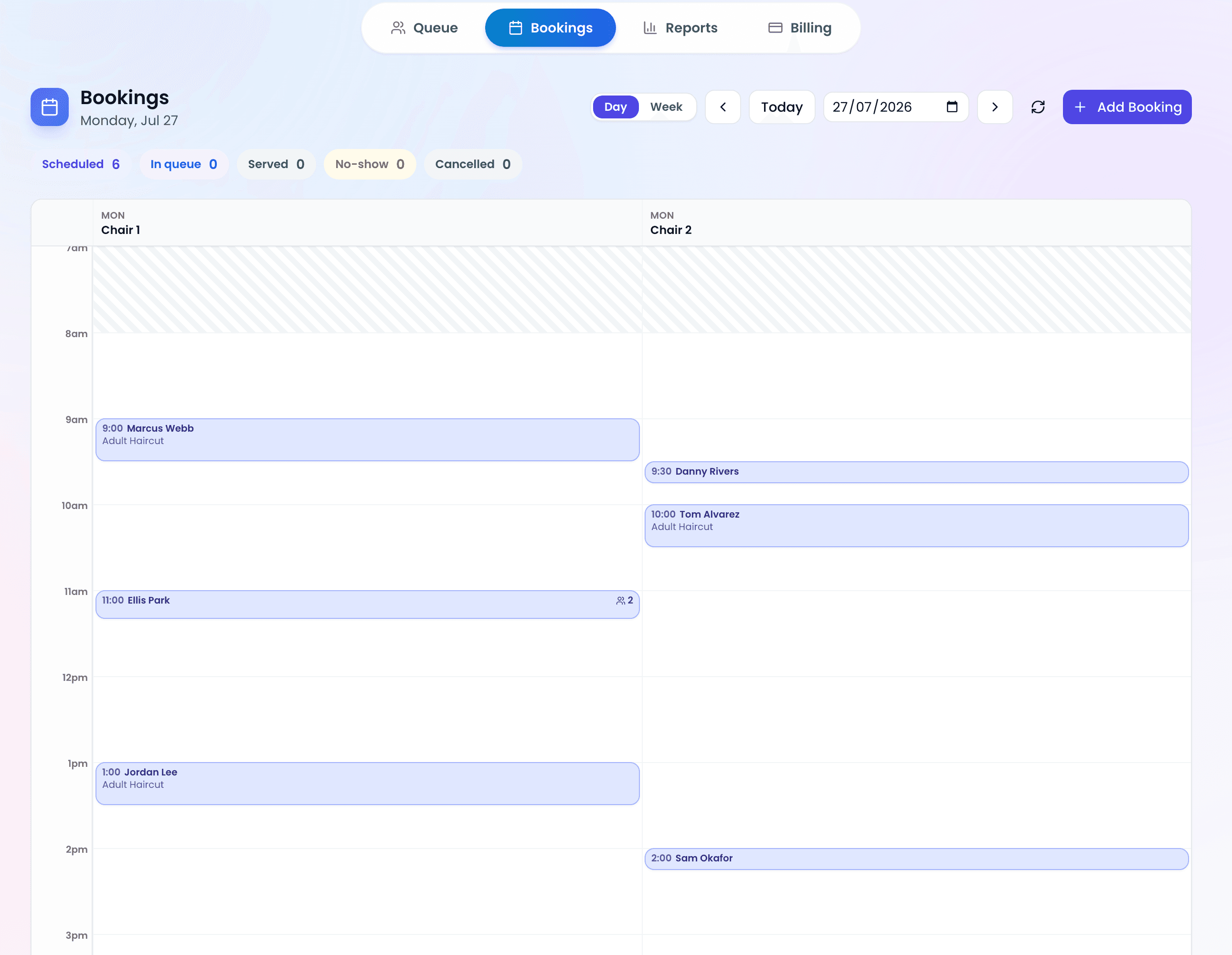
For services that take a predictable amount of time (clinics, salons, consultations), offering appointments alongside walk-ins lets you control flow. Appointments fill your schedule baseline, while walk-ins fill gaps.
The key is to not overbook appointments. Leave 20–30% of your capacity for walk-ins, and use a queue system to manage them. This hybrid approach gives customers choice and keeps your operation running smoothly.
8. Create Express Lanes for Quick Services
If some of your services are quick (under 10 minutes) and others are long (30+ minutes), mixing them in one queue creates frustration for everyone. The quick customer waits behind the long one. The long customer feels pressured.
Creating separate queues or services for quick vs. standard tasks lets you serve fast customers immediately while giving complex tasks the time they need. Multi-service queue systems like ScanQueue handle this automatically — customers select their service type when joining.
9. Communicate Wait Times Transparently
Uncertain waits feel longer than known waits. Telling a customer "it'll be about 20 minutes" transforms their experience even if the actual wait doesn't change. Transparency sets expectations and lets customers make informed decisions.
Digital queue systems display real-time wait estimates on the customer's phone.
Pro Tip — Under-Promise, Over-Deliver: If your average wait is 15 minutes, display 18–20 minutes. When customers are served early, they feel pleasantly surprised. When it's accurate, they're still satisfied because expectations were set.
10. Collect Feedback and Iterate
The businesses with the shortest wait times aren't the ones with the best initial setup — they're the ones that continuously improve. Set up a simple feedback mechanism (even a "How was your wait?" question after service) and review it weekly.
Pair customer feedback with your queue analytics data to identify which strategies are working and where friction remains. The combination of quantitative data and qualitative feedback gives you a complete picture.
Quick Implementation Priority
If you're wondering where to start, here's a priority ranking based on impact vs. effort:
| Strategy | Impact | Effort | Priority |
|---|---|---|---|
| Virtual queuing | High | Low | 1st |
| SMS notifications | High | Low | 2nd |
| Wait time transparency | High | Low | 3rd |
| Self-service check-in | Medium | Low | 4th |
| Queue analytics | Medium | Low | 5th |
| Peak staffing | High | Medium | 6th |
| Service optimization | Medium | Medium | 7th |
| Express lanes | Medium | Medium | 8th |
| Appointment slots | Medium | High | 9th |
| Feedback loop | Low (compounds) | Low | 10th |
Frequently Asked Questions
What is the biggest cause of long wait times?
For most service businesses, the biggest cause is unpredictable demand combined with fixed staffing. When customer arrivals spike beyond your capacity, a queue forms. Virtual queuing, peak staffing, and analytics are the best combination to address this.
How much do long wait times cost a business?
It varies by business type. For a restaurant with a $50 average spend, losing 5 customers per day to walkaways costs over $54,000 annually. See our ROI calculator for detailed figures.
Can you reduce wait times without spending money?
Yes. Process optimization, better communication, and smarter scheduling cost nothing. However, the highest-impact strategies (virtual queuing, SMS notifications, analytics) require a queue management system. Free tiers are available — ScanQueue's Starter plan costs $0.
What is an acceptable wait time for customers?
It depends on the service and on what customers expect when they arrive. What matters as much as the actual time is whether the wait is communicated clearly, because uncertain waits feel longer than known ones.
Related: Go deeper on the tech tools that cut wait times in busy service businesses.
Start Reducing Wait Times Today
Virtual queuing, SMS notifications, and analytics — all included. Free plan available.
Try ScanQueue Free →Stop losing walk-ins to wait times
Set up ScanQueue in 5 minutes. Customers scan a QR code, get SMS alerts when it's their turn, and wait anywhere.
- Free plan — no credit card
- No app download for customers
- QR code, SMS, and WhatsApp notifications
ScanQueue Team
Queue Management Experts
Helping businesses reduce wait times and improve customer experience with smart queue management solutions.