Every line you have ever stood in, from the supermarket checkout to a call center hold, follows a set of predictable mathematical rules. The study of those rules is called queuing theory, and it is the quiet engine behind everything from staffing schedules to the wait-time estimate on your phone.
The short version: queuing theory is the math of waiting lines. It predicts how long people will wait and how many servers you need, using just a few inputs: how fast customers arrive and how fast you serve them.
What Is Queuing Theory?
Queuing theory is the mathematical study of waiting lines. It models how customers or items arrive, wait, and get served, so you can predict queue length, wait time, and the number of servers required to keep things flowing.
The field was founded by Danish engineer Agner Krarup Erlang in 1909. Working for the Copenhagen Telephone Exchange, he wanted to know how many phone lines a town needed so that callers rarely got a busy signal. The math he developed to answer that question now underpins call centers, hospitals, web servers, and walk-in businesses of every kind.
The Key Concepts in Queuing Theory
Almost every queuing model is built from the same handful of variables:
- Arrival rate (lambda): how many customers arrive per unit of time, for example 30 per hour.
- Service rate (mu): how many customers one server can handle per unit of time.
- Number of servers (c): how many counters, staff, or checkout lanes are open.
- Utilization (rho): how busy the system is, calculated as arrival rate divided by total service capacity. Above about 85% and wait times rise sharply.
- Queue discipline: the order people are served in, usually first come first served (FIFO).
Little's Law: The One Formula to Know
If you remember one thing from queuing theory, make it Little's Law. It is remarkably simple and works for almost any stable queue:
Little's Law: L = lambda times W. The average number of people in the system (L) equals the arrival rate (lambda) multiplied by the average time each person spends in the system (W).
A worked example: if 30 customers arrive per hour and each one spends an average of 10 minutes (one sixth of an hour) waiting and being served, then the average number of people in your shop at any moment is 30 times one sixth, which equals 5. Flip it around and you can solve for wait time instead. That is the power of the formula: know any two values and you can find the third.
Common Queuing Models (Kendall Notation)
Queues are classified using Kendall notation, written as A/S/c: the arrival pattern, the service pattern, and the number of servers. The most common models are:
- M/M/1: the simplest case. Random arrivals, random service times, and a single server. Think of one barber with a walk-in chair.
- M/M/c: random arrivals and service, but with several servers sharing one line. A bank with five tellers and one waiting line.
- M/G/1: random arrivals but a general (any) service-time distribution, with one server. Useful when service times are not random, like a fixed-length appointment.
- M/M/c/K: adds a capacity limit (K), the most you can hold before turning people away. A waiting room with only so many chairs.
Single Line vs Multiple Lines: What the Math Says
Here is one of queuing theory's most useful real-world findings. A single shared line that feeds several servers (an M/M/c queue) produces shorter and more predictable average waits than giving each server their own separate line.
The reason is simple: with separate lines, you can get stuck behind one slow customer while a neighbouring line moves fast. A single line removes that bad luck, so no one waits much longer than anyone else. It is also why banks and airports switched to one snaking queue years ago. The perception of fairness matters as much as the math, a point we cover in our guide to queue psychology.
How Businesses Use Queuing Theory
You do not need a maths degree to benefit from this. The practical applications show up everywhere:
- Staffing: work out how many counters or staff to open at each hour so utilization stays below the danger zone.
- Wait-time estimates: give customers an accurate ETA instead of a guess, which is the single biggest driver of satisfaction.
- Reducing walkouts: predict when lines will build and act before customers give up and leave.
- Layout decisions: choose a single line over multiple lines, or add a server, backed by numbers rather than guesswork.
Applying Queuing Theory Without the Math
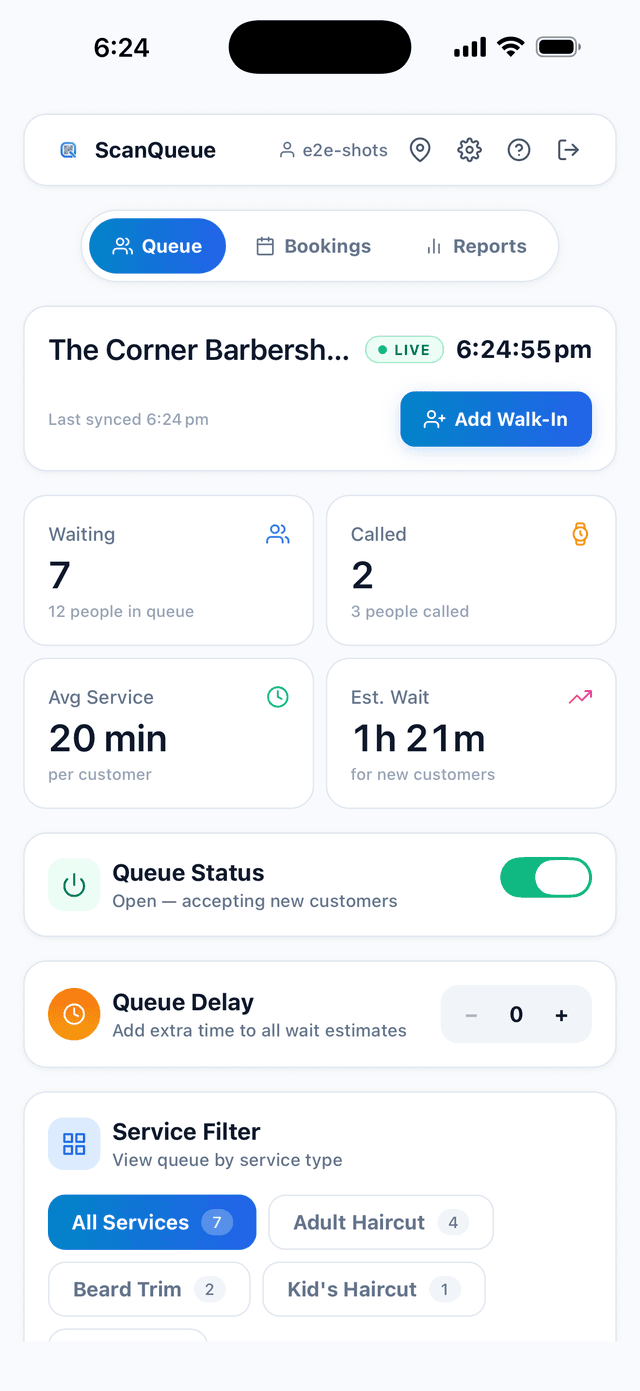
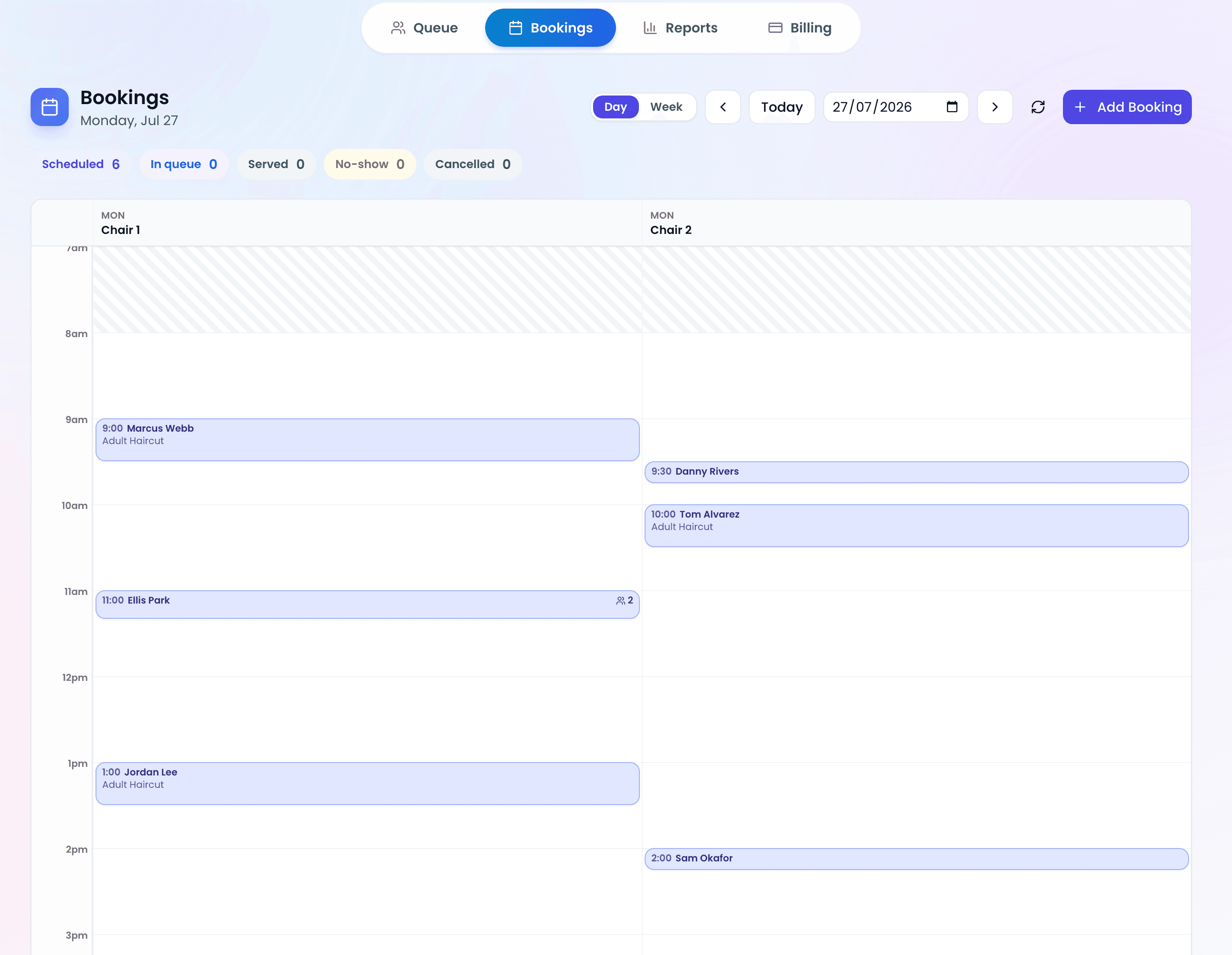
The good news for most businesses: you do not have to calculate any of this by hand. A modern queue management system measures your real arrival and service rates automatically, then applies these principles to show live positions and accurate wait times.
Instead of a physical line, customers join a virtual queue from their phone and wait wherever they like, while the system handles the theory in the background. To turn these ideas into shorter real-world waits, see our guide on how to reduce customer wait times. And if the spelling has ever tripped you up, here is the difference between queue and que.
Stop losing walk-ins to wait times
Set up ScanQueue in 5 minutes. Customers scan a QR code, get SMS alerts when it's their turn, and wait anywhere.
- Free plan — no credit card
- No app download for customers
- QR code, SMS, WhatsApp, and voice notifications
ScanQueue Team
Queue Management Experts
Helping businesses reduce wait times and improve customer experience with smart queue management solutions.