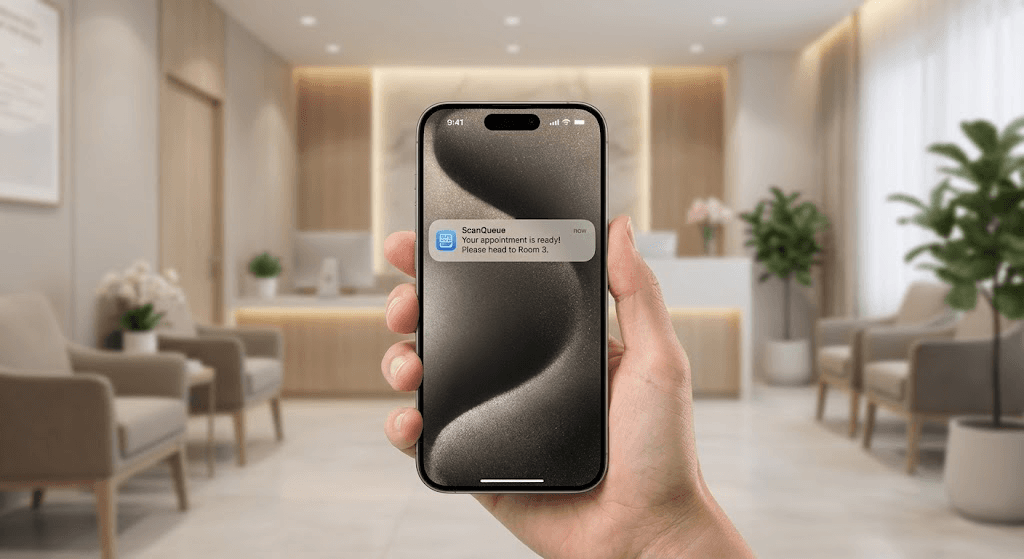
The one-stop student services model solves a real problem. Instead of sending a student with a timetable clash, an unpaid fee, and a broken login to three different offices in three different buildings, the institution gives them one place to go.
It also creates a new problem. A single front door produces a single queue, and that queue now mixes a two-minute ID card collection with a twenty-minute financial aid conversation. Handled naively, the one-stop centre delivers a worse wait than the departmental offices it replaced, and students notice.
One Front Door, Several Queues
The resolution is to keep the single front door as a student-facing concept while running separate queues behind it. When a student joins, they pick what they actually need. Behind the counter, each service is its own queue with its own staff and its own wait estimate.
Nothing about the student's mental model changes: they still go to one place and join one thing. What changes is that a quick case is no longer trapped behind a slow one, and staff can be assigned by specialism rather than by whoever is next free.
The University of Roehampton ran its 2026 enrolment this way on ScanQueue: one front door and one QR code, but six queues behind it (Card Collection, Student Immigration, Finance, Admissions, Registry and Finance Referral). Across 14 August to 3 October, 11,632 students joined, and the busiest single queue, card collection with 3,482 students, did not sit in front of students who only needed the finance desk.
The Re-Queue Trap
The most damaging failure in a one-stop centre is the bounce. A student waits twenty minutes, reaches the desk, and discovers their case belongs to a different service. If the response is "join that queue", the student has been punished for the institution's routing error, and the one-stop promise is broken in the most visible way possible.
Two things prevent it. First, ask what the student needs at the moment they join rather than at the moment they are served, so misrouting is caught before the wait rather than after it. Second, let staff move a student to the right desk from the dashboard, keeping the same queue entry, rather than requiring them to rejoin from the back.
Measuring the Centre Properly
A one-stop centre reported as a single number is close to useless for capacity planning. An average wait across all services tells you the centre is busy, but not which desk to staff.
Per-service volume and wait time answers a different and far more actionable question: which service is generating the queue. It is common for one service to account for most of the wait while representing a minority of the visits, and that is a staffing decision that a centre-level average actively conceals.
Letting Students Wait Somewhere Else
A one-stop centre concentrates footfall by design, which makes the waiting area the constraint. Allowing students to hold their place from their phone and be called by SMS or WhatsApp turns the waiting room from a hard capacity limit into a soft one. The centre serves the same number of students; it just stops needing to contain all of them simultaneously.
For institutions running several centres or campuses, each runs as its own branch with separate queues and reporting under one institutional account. See multi-location queue management for how that structure works.
Built for Student Service Centres
Run one front door with separate queues per service, move students to the right desk without a re-queue, and report per service rather than per centre.
Explore Higher Education Solutions →Last updated: July 2026
Run student services? See our university queue management.
Stop losing walk-ins to wait times
Set up ScanQueue in 5 minutes. Customers scan a QR code, get SMS alerts when it's their turn, and wait anywhere.
- Free plan — no credit card
- No app download for customers
- QR code, SMS, and WhatsApp notifications
ScanQueue Team
Queue Management Experts
Helping businesses reduce wait times and improve customer experience with smart queue management solutions.