University enrolment queue management is the problem of absorbing a term's worth of student service demand into a handful of days. For most of the year, a student services centre is quiet enough that a walk-up counter works fine. For two weeks around enrolment and registration, the same counter faces a queue that runs out the door and down the corridor.
Hiring temporary counter staff is the usual answer, and it is expensive, slow to arrange, and only partly effective: more counters do not help if the bottleneck is the corridor rather than the desk. The alternative is to stop requiring students to physically occupy the queue in order to hold a place in it.
How can universities reduce queues at student services during enrolment week?
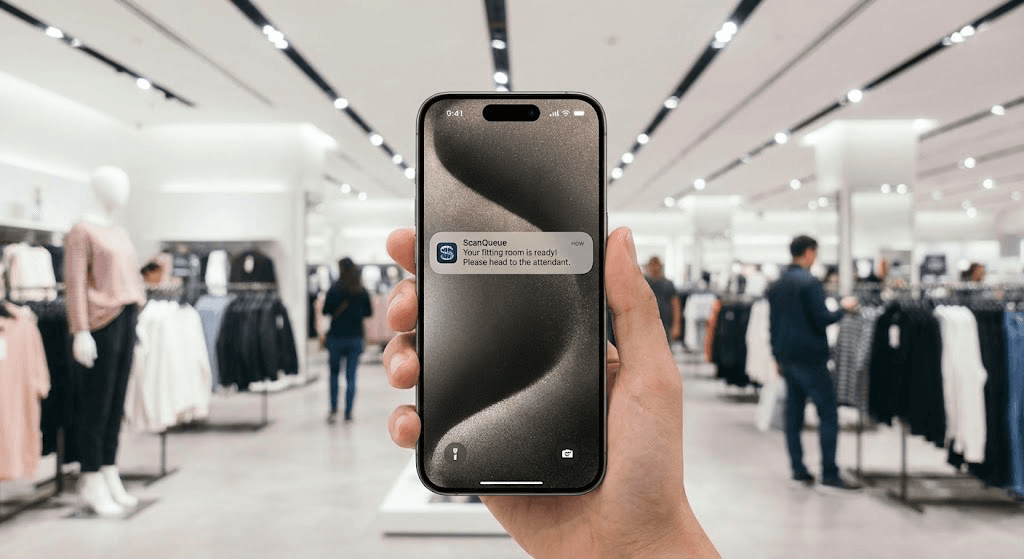
Split the single corridor queue into one virtual queue per service and let students join from their phones, so they can wait anywhere on campus until a message tells them their desk is ready. ScanQueue, for example, does this with a QR code and no app, calling students by WhatsApp or SMS; the University of Roehampton used it for six services during its 2026 enrolment, when 11,632 students joined.
Why Enrolment Queues Behave Differently
Enrolment-period queues have three properties that make them harder than an ordinary service line.
The Demand Is Compressed, Not Just High
A retail queue spreads across trading hours. An enrolment queue concentrates into the first hour of the first days, because deadlines and timetable releases push everyone to act at the same moment. Staffing to the peak means overstaffing for the rest of the term.
Students Have Competing Fixed Commitments
Unlike a customer with a free afternoon, a student in an enrolment queue often has a lecture, a lab, or an induction session starting shortly. A queue that requires physical presence forces a choice between resolving an administrative problem and attending teaching. Many students leave the queue, and the problem returns the following day, larger.
One Queue Hides Several Different Services
A single corridor line usually contains students who need entirely different things: a timetable clash, a fee payment question, an ID card, a password reset. Serving them from one undifferentiated queue means every student waits behind the slowest case type, and staff cannot specialise.
The Core Change: Separate Joining From Waiting
The single highest-impact change is to decouple holding a place in the queue from standing in it. Students scan a QR code at the service centre entrance, or open a link from the enrolment page, and join from wherever they are. They see their position and estimated wait on their phone, and receive an SMS or WhatsApp message when it is their turn.
This does not increase counter throughput. What it changes is everything around the counter:
- Corridors clear. The queue still exists, but it is distributed across the campus rather than occupying a single hallway, which removes the fire-safety and accessibility pressure that long physical lines create.
- Fewer students abandon. A student who can attend their lecture while holding position does not have to choose between the two, so the same demand resolves in fewer visits.
- Staff stop fielding "how long?" Position and estimated wait are visible on the student's own phone, so counter staff spend their time serving rather than answering status questions.
Splitting the Queue by Service
The second change is to stop running one queue. Enrolment and registration, fees and financial aid, ID cards, and IT support have different handling times and different staff. Running them as separate queues under one service centre means a two-minute ID card collection is not stuck behind a twenty-minute fee dispute.
Students select the service they need when they join, which also routes them to the right desk the first time. For institutions running a one-stop shop model, the queues can still be presented as a single front door while remaining separately staffed and separately measured behind it.
Multi-Campus and Multi-Centre Institutions
Institutions with several campuses or several service centres run each as its own branch under one institutional account. Each campus keeps its own queues, its own staff accounts, and its own reporting, while central administration retains a view across the whole estate. A student joining at one campus sees only that campus's queues.
This matters most in the review after enrolment week: per-campus reporting shows which service centres were genuinely over capacity and which simply had poor signage, which is the difference between a staffing decision and a communications fix. See multi-location queue management for how the hub and branch structure works.
Example: the University of Roehampton's 2026 Enrolment
The University of Roehampton in London ran its autumn 2026 enrolment on ScanQueue, split by service exactly as described above. Between 14 August and 3 October, 11,632 students joined from their phones and 9,395 were served, with 1,465 joining on the busiest day, 21 September. Each service kept its own queue:
- Card Collection: 3,482 students
- Student Immigration: 2,857 students
- Finance: 2,319 students
- Admissions: 1,946 students
- Registry: 958 students
Card collection alone drew more students than registry and admissions combined, which is the case for separate queues: a student collecting an ID card never stood behind a visa check. See how ScanQueue works for universities.
Preparing for the Next Enrolment Period
- Identify the real bottleneck first. Count how many students in last year's queue needed each service. The split usually surprises people, and it determines how you divide the queues.
- Put the join point before the building. A QR code at the entrance still produces a corridor. Publishing the join link on the enrolment page and in enrolment emails lets students join before they arrive.
- Brief the counter staff on calling, not queueing. The operational change for staff is small but real: they call the next student from a dashboard rather than looking up at a line.
- Run one service centre first. Enrolment week is a poor moment for an estate-wide rollout. One centre, one term, then expand on evidence.
Queue Management Built for Universities
Students join from their phone and get called by SMS or WhatsApp, so service desks stay clear through enrolment week. Each campus runs its own queues, staff, and reporting.
Explore Higher Education Solutions →Last updated: July 2026
Run student services? See our university queue management.
Stop losing walk-ins to wait times
Set up ScanQueue in 5 minutes. Customers scan a QR code, get SMS alerts when it's their turn, and wait anywhere.
- Free plan — no credit card
- No app download for customers
- QR code, SMS, and WhatsApp notifications
ScanQueue Team
Queue Management Experts
Helping businesses reduce wait times and improve customer experience with smart queue management solutions.